知识点
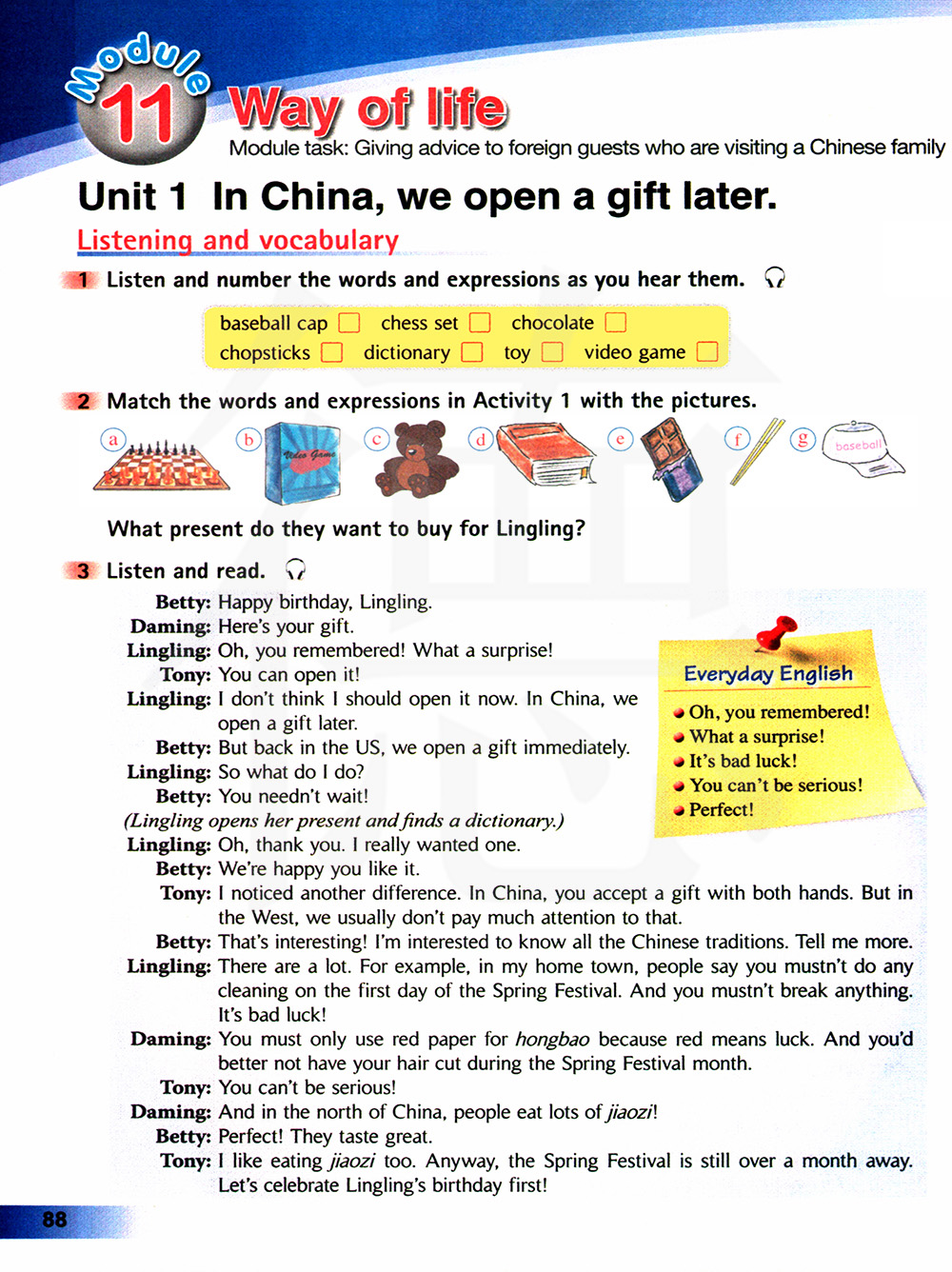
1. a chess set 一副国际象棋
2.video game 电子游戏
3. do some cleaning 打扫卫生
4. bad luck 倒霉
5. the Spring Festival 春节
6. get married 结婚
7. for example 例如
8. for the first time 首次;初次
9. shake hands 握手
10. have afternoon tea 喝下午茶
11. light meal 便餐;便饭
12. be different from 与……不同
13. each other 互相
14. on time 准时;按时
15. look up 查寻
16. at the age of 在……岁时
17. clean up 打扫干净
18. wash up 洗刷;饭后洗餐具
19. stay out 待在户外;不回家
20. can't wait to 迫不及待
21. make mistakes 犯错;出错
重点语法:
1. here is your gift. 这是你的礼物
这是一句由here引导的倒装句,即here+谓语+主语,此外there也有这样的用法。
Eg: There comes the bus.
注意:只有当主语是普通名词时才能够用倒装句,如果是代词则不能。
Eg: Here you are.
2. what a surprise! 真惊讶啊! to one’s surprise 令sb 惊奇的是 此句是感叹句,用来表达赞美、惊叹、喜悦等感情,同样用how 也可引导感叹句。结构如 下:
what +(a\an)+adj.+n.(+主语+谓语 )!
how +adj.\adv. (+主语+谓语 )!
Eg: How beautiful the girl is!
What a beautiful girl she is!
3. you needn’t wait. 你不必等了。
need在这里用作情态动词,表示“需要”,常用于否定句、疑问句及must 引导的一般疑问句的否定回答,其后用动词原形。 (needn’t=don’t have to)
Eg: You needn’t come to school this afternoon.
---Must I finish my homework today?
--- No, you needn’t.
【拓展】need作实义动词时,其后可接to do,也可接doing,表示“需要做 sth”
当句子主语是人时,用 need to do sth
Eg: I need to take some exercise every morning.
当句子主语是物时,用 need doing sth
Eg: Our classroom needs cleaning everyday.
4. difference(n.) 不同之处,区别→different(adj.)不同的
be different from pay attention to doing sth
5. accept (主动) 接受 receive 收到,得到
Eg: She received a present, but she didn’t accept it.
6. do some cleaning 打扫卫生(这是一个由do+some+doing构成的短语 ) Eg: You should help your mother do some cleaning after school.
【拓展】 do some washing\cooking\shopping\sewing
7. had better (not) do sth 最好(不) 做 sth
Eg: We had better take an umbrella.
You’d better not go out in the evening.
8. experience(n.) 经历(可数名词 ) 经验、体验(不可数名词 )
9. enjoy doing sth enjoy oneself=have a good\nice time something interesting 有趣的事(当adj.碰到不定代词时,应把adj.放在后面 )
Eg: Mike enjoys watching football matches.
Can you tell something different between the two pictures?
10. get to know 了解,认识
Eg: Do you get to know my friend Bill?
11. not……but…… 不是……而是……(but表示转折 )
Eg: She wants to buys not a skirt, but a dress.
【拓展】not only……but (also)……(表示递进 )
Eg: He can speak not Chinese but also English.
12. traditional(adj.) 传统的 → tradition(n.) 传统
take away 拿走(代词只能放在中间,名词放中间和后面均可 )
13. stop v. 停止 stop to do sth stop doing sth
n. 停靠站 bus stop
turn v. 转(弯);变得 turn left turn green
n. 顺序 It is your turn.
14. at a age of =when sb is……years old. 在…… 岁时
15. stay out 不回家;待在外面 stay at home stay up 熬夜 back-to-front 前后颠倒,穿反了
Eg: Yesterday he stayed out after 12 o’clock.
It’s rainy day, let’s stay at home.
We’d better not stay up, it is bad for our health.
He put his sweater on back-to-front.