知识点
1.关于天气的单词:
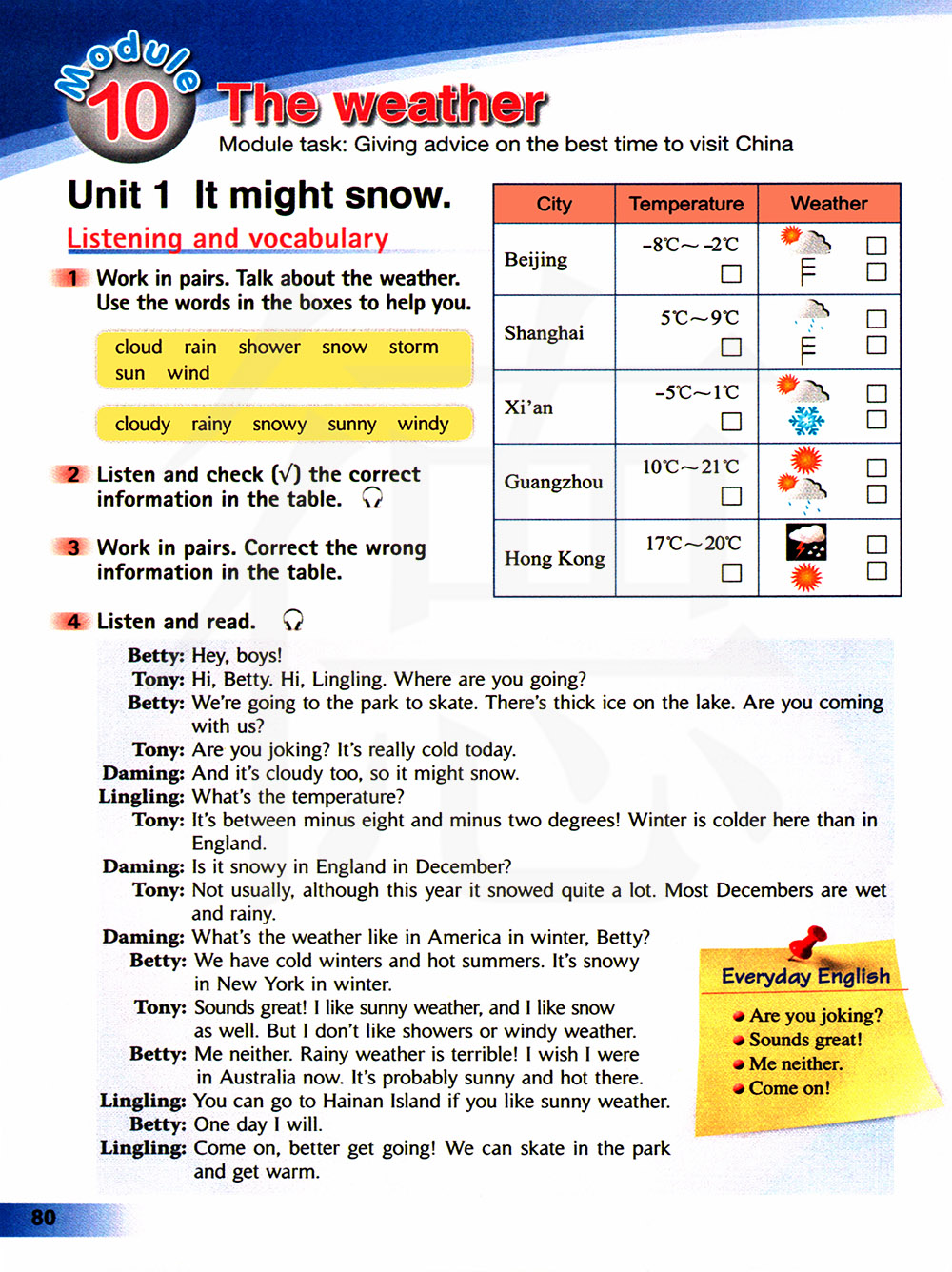
名词 cloud rain snow sun wind fog
形容词 cloudy rainy snowy sunny windy foggy
2.Are you coming with us?
这是一个用现在进行时表示将来的句子,在英语中,如go\come\arrive\leave等可以用现在进行时表示按计划或安排将来发生的动作。
Eg:My father is arriving in England tomorrow.
3.Are you joking? joke n. 笑话;玩笑 play a joke on sb make a joke of\about ab v. 开玩笑
Eg:It is impolite to play a joke on the old.
4. minus 减去 零下(温度)
Eg:Two minus one is one.
The temperature is minus 3 degrees.
5.although 尽管;虽然(although与but不能连用)
Eg:It isn’t warm today, although the sun is shining.
6. what’s the weather like (in sp)?
Eg:---What is the weather like in Jinhua today?
---It is cold today.
询问天气还可以用how is thel weather (in sp)? weather 是不可数名词,不可以用a\an修饰l
7.as well 也;还(放句末) too也(放句末) also 也,而且(放句中)
8. neither……nor…… 既不……也不……(两者都不)
either……or…… 或者……或者……(两者之一)
这两个短语在判断主谓一致时遵循就近原则。
Eg:Either he or I clean the blackboard.
9. probably 可能,或许 可能性大→小:probably →perhaps→ maybe
10. come on的用法:
“快点” 催促别人快走或快做 Come on, it is gettingl dark.
“来吧” 用来鼓励,劝说别人 Come on, Lucy. Don’t be shy.l
“加油” 用于比赛场合 Come on, Class Six.
11. better get going.= had better g now. 最好现在就走
had better do sth 最好做sth
Eg:It’s late now, we had better hurry up.
12. bring sth to sp 把sth带到sp来
take sth to sp 把sth带到sp去
Eg:Don’t forget to bring your homework to me tomorrow.
Please take these books to the library for me.
13. get cooler, turn gold
此处get\turn都表示“变得” 另外become\go\grow也可以表示“变得”Eg:The winter is coming, it gets colder and colder.
14. take photo of 拍……照片
all year round 全年
15. compared to = compared with 和……相比较
Eg:I compared my computer to\with hers.
16. from time to time 时常,偶尔
at the same time 同时
in time 及时
on time 按时
have a good time 玩得开心
17. 时间+later=after +时间 ……以后
Eg:Two years later he left our school
=He left our school after two years.
18. join 加入(党、军队、组织等)
join in 参加(小规模的活动,如游戏等)
Eg:When did you join the Party?
Come and join in the match.
19. the best time to do sth 做sth的最好时间
the first time to do sth 第一次做sth
Eg:The best time to visit Harbin is in winter.
The first time to visit Harbin is in 2012.
GRAMMER: 情态动词本身有一定的词义,为谓语动词增添情态色彩,表示说话人对有关行为或事物的态度和看法,认为有可能,应该或有必要等。情态动词无人称和数的变化,其后接的动词需用原形,否定式是在情态动词后加上not.
一.当我们想表达可能发生某事以及某人可能做某事时,可以用may/might.
You may /might be right .
He may/might tell his wife .
May与might 没有太大区别,形式上might 是may的过去式,但在表示将来的可能情况时,might表示的可能性比may 表示的可能性还要小。
They may come tomorrow .
There might be some rain tomorrow morning.
二. ①possible 表示可能性
形容词possible 表示可能性,常用句型有:
It is possible to do sth .
It is possible that …
EG: Is it possible to finish the work today ?
It is possible that it’ll be snowy tomorrow.
②probably 和possible 都表示可能性
Probably和possible 都表示可能性。 Probably 表示“很可能” ,它所表示的可能性比possibly 大。
常用句型有:
主语 + will + probably/possibly +v. +…
EG: It’ll probably be sunny and hot.
Mr. Wang will possibly agree.