400-686-5604

退出 登录 | 注册

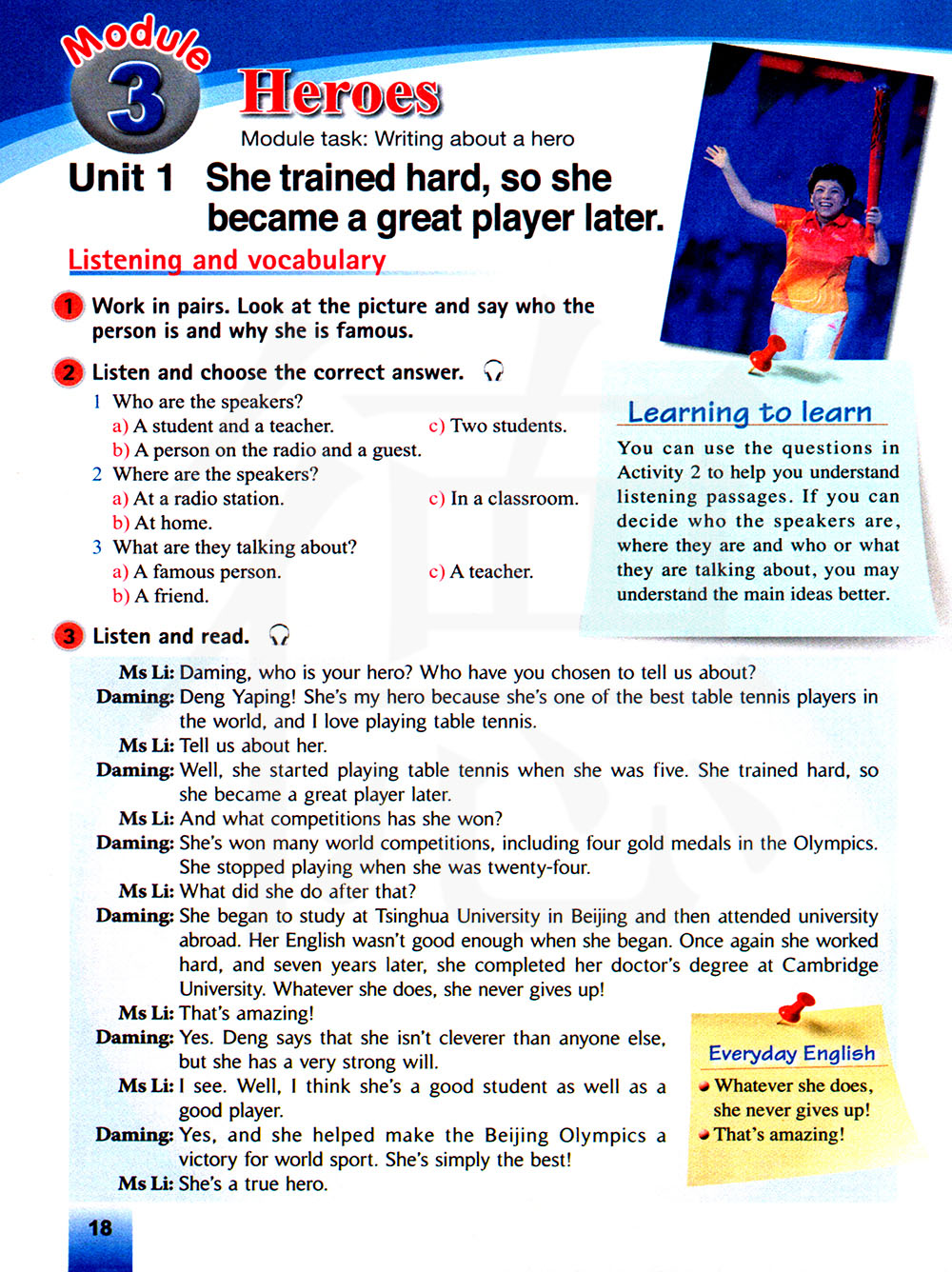
模块三 英雄
模块任务:描写一位英雄
第一单元 她刻苦训练,所以她后来成了一位伟大的运动员。
听力与词汇
两人一组。看图说说这个人是谁,她为什么出名。
听录音选择正确的答案。
学会学习
你可以用活动2中的问题帮你理解听力文章。如果你可以判断谁是说话人,他们在哪里,他们在谈论什么人或什么事,也许你可以更好的理解文章的大意。
听一听并阅读。
大明,谁是你的英雄?你要给我讲述谁?
邓亚萍!她是我的英雄,因为他是世界上最好的乒乓球运动员之一,而且我喜欢打乒乓球。
给我们介绍一下她。
嗯。她五岁开始打乒乓球。她刻苦训练,所以她后来成了一位伟大的运动员。
她赢了哪些比赛?
她赢了很多世界级比赛,包括四枚奥运会金牌。她在24岁的时候退役了。
在那以后,她干什么?
她开始在北京的清华大学学习,之后去了国外的大学。在开始的时候,她的英语不是很好。她再一次刻苦学习,七年以后,她在剑桥大学完成了她的博士学位的学习。无论做什么,她都不放弃!
那真是太神奇了!
是的。邓亚萍说他并不比别人聪明,但是她有非常坚强的意志。
我明白了。嗯,我觉得她不紧是一个出色的运动员,而且还是一个好学生。
是的,而且他还帮助使得北京奥运会成为世界运动会上的一次胜利。她显然是最棒的!她是一位真正的英雄。
日常英语
无论做什么,她都不放弃!那真是太神奇了。
知识点

<p> <strong>短语归纳</strong>  </p> <p> 1.  choose to do sth. 选择做某事     We choose to join the English club. </p> <p> 2.  tell sb. About sth. 告诉某人关于某事    Please tell me about your vacation plan. </p> <p> 3.  one of the + 形容词最高级 + 可数名词的复数形式,最……的……之一      She is one of the most famous singers in China. </p> <p> 4.  in the world 在世界上           </p> <p> 5. play table tennis打乒乓球</p> <p> 6.  stopping doing sth. 停止正在做的事  stop to do sth. 停下去做另外一件事   </p> <p>    They stopped working and decided to have a rest.   </p> <p>     He stopped to talk with me.  </p> <p> 7.  attend university abroad 出国留学    attend a meeting 参加一次会议 </p> <p> 8.  Whatever she does, she never gives up. 无论她做什么,她从不放弃。   </p> <p>     whatever = no matter what 无论什么 </p> <p>     Take whatever you want. 你想要什么就拿什么   </p> <p>     give up doing sth. = stop doing sth. 放弃做某事 </p> <p>     You should give up smoking at once. </p> <p> 9. have a strong will 有坚强的意志 </p> <p> 10. as well as  不但……而且;还    She can speak English as well as Japanese.   </p> <p>   as well as  同……一样好(同级比较的结构)   He plays the piano as well as you.</p> <p> 11.  She is simply the best.    她确实是最好的。 </p> <p> 12. die for 为……而死   He died for the country . </p> <p> 13. take care of = look after 照顾;护理     take good care of … = look after … well  好好照顾 </p> <p> 14. the + 形容词,表示某一类人,表示复数意义,若用作主语,谓语动词用复数形式。   </p> <p>   the rich富人   the poor穷人    the sick病人   the old老人   the young年轻人  the weak弱者  the strong强者   the blind失明的人      the wounded伤员  </p> <p>   The rich get richer and the poor get poorer. 富者愈富,贫者愈贫。 </p> <p> 15.  so that以便; 为的是 (从句中出现情态动词,so that引导的是目的状语从句)      </p> <p>   He got up early so that he could catch the early bus.   </p> <p>   He got up early so that he caught the early bus.  </p> <p>   (从句中用的是行为动词的过去时,so that引导的是结果状语从句) </p> <p> 16.  invent v. 发明  invention n. 发明物   inventor n. 发明家   </p> <p>     Can you tell me who invented the telephone?    </p> <p>    He wants to be an inventor when he grows up.    </p> <p>    What do you think is the most important inventions? </p> <p> 17.  at that time 那时候,在那时 </p> <p> 18. on one’s own = by oneself = alone 独自;单独     </p> <p>   The girl can finish the work on her own / by herself. </p> <p> 19. It’s useful for sb. to do sth. 做某事对某人有用  It’s useful for you to know the rules.  </p> <p>    be useful to sb. 对某人有用   This book is useful to young people.    </p> <p>    be useful for (doing) sth. 某事/某物有用 Dictionaries are useful for learning English. </p> <p> 20. without doing sth. 没有做某事(做伴随状语)    He went to school without eating breakfast.     </p> <p>   without sth. 没有某物    We went out without any money. </p> <p> 21. manage to do sth. 设法做成某事    He managed to avoid an accident. </p> <p> 22. operate v. 做手术  n. operation 手术    </p> <p>   operate on +sb./某部位     The doctor is operating on a boy / his leg.    </p> <p>   do an operation on sb. 给某人做手术   The doctor is doing an operation on a girl. </p> <p> 23. continue doing sth. 继续做原来的事  continue to do sth. 继续做另一件事   </p> <p>   He continued reading Lesson Ten.   </p> <p>   They continued talking after the meal.    </p> <p>   After reading Lesson Nine, he continued to read Lesson Ten. </p> <p> 24. in the end = at last = finally 最后;终于   In the end he finished the work on time. </p> <p> 25. die of 因……而死(内因)后跟hunger, cold, illness, a fever等名词。    The man died of his illness. </p> <p>   die from 由于…而死(外因)后跟wound, accident, over work, carelessness等名词。  The soldier died from his wound.  </p> <p> 26. make +宾语 +宾语补足语(名词/形容词)     We made him our monitor. 我们选他当我们的班长。    The presents made us excited. </p> <p> 27. take off (飞机等)起飞;脱下(衣服等)     The plane took off at nine.    He took off his wet shoes. 他脱下了浸湿的鞋子。 </p> <p> 28. around the world = all over the world 世界各地,全世界 </p> <p> 29. in need of需要 need n. The doctor told me I was in need of a good doctor. </p> <p> 30. be proud of 为……感到自豪  They are proud of their brave soldiers. </p> <p> 31. set off/ out =start off/ out  出发;动身     set off for… 动身/出发去…  They set off for home then. </p> <p> 32. get away  离开,逃离  I hope to get away early in the morning.       </p> <p> 33. learn from向......学习   learn sth. from sb. 向某人学习某事   </p> <p>    Let’s learn from Lei Feng.   </p> <p>    I am learning English from Tom. </p> <p> 34. on one’s way home在某人回家的路上   I bought a book on my way home. </p> <p> 35. save one’s life 挽救某人的生命    The doctor tried his best to save the boy’s life 36.once again再一次 </p> <p> <strong>用法集萃  </strong></p> <p> 1. one of +the+形容词最高级+可数名词复数   最.....的......之一 </p> <p> 2.tell sb. about sth.告诉某人关于某事      </p> <p> 3.start doing sth.开始做做某事          </p> <p> 4.begin to do sth.开始做某事     </p> <p> 5.stop doing sth.停止做某事            </p> <p> 6.on one's own独自一人                 </p> <p> 7.manage to do sth.设法完成某事 </p> <p> 8.both...and...    .......和......两者都       </p> <p> 9.want to do sth.想做某事 </p> <p> 10.make sb/sth. +形容词  使某人/某物...... </p> <p> 11.try to do sth.努力干某事               </p> <p> 12.wait for sb. to do sth.等待某人做某事 </p>

题库

课后题