知识点
知识点
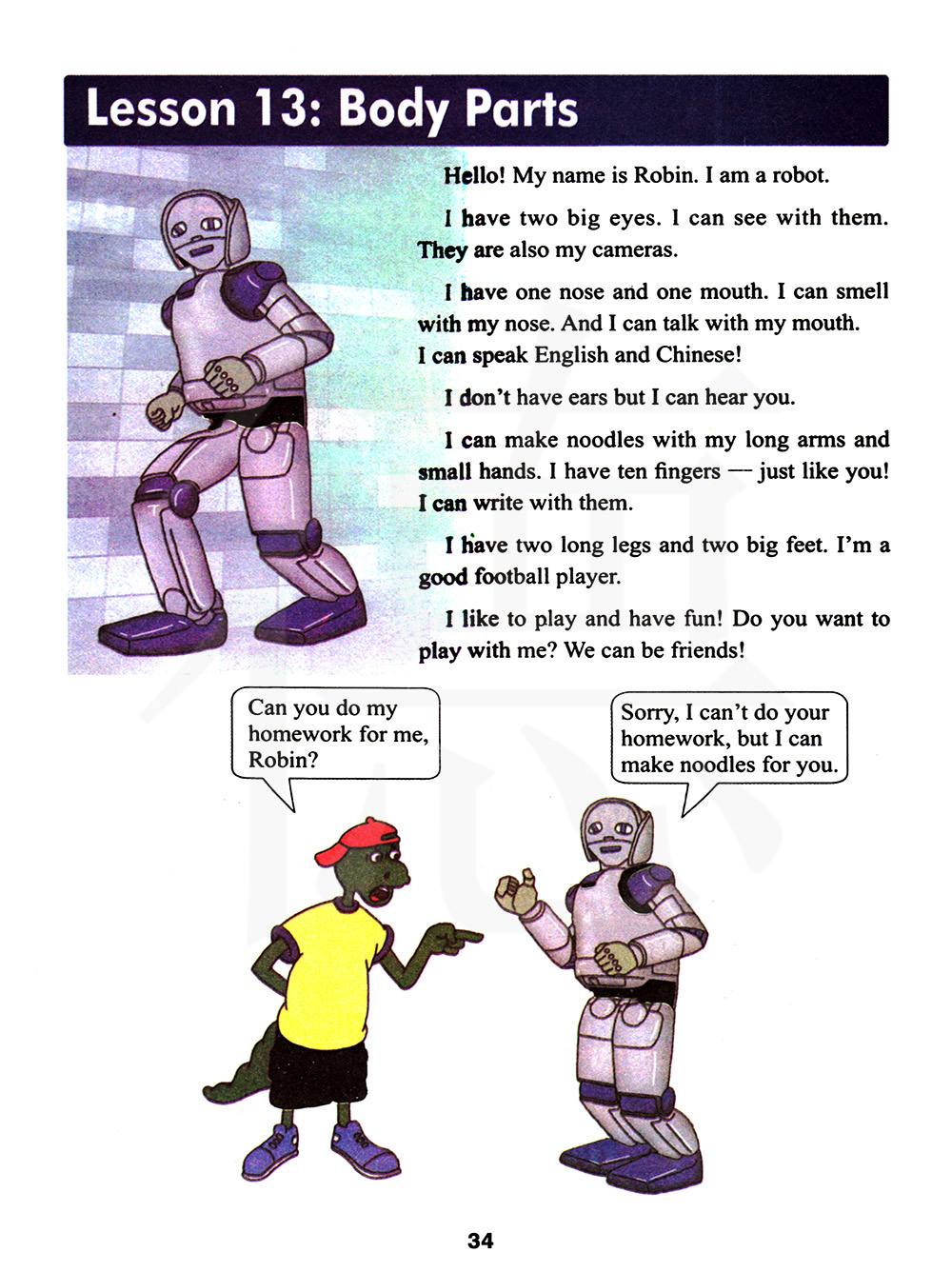
1. I can see with them. 我能用它们看(东西)。 with 介词,“用 (工具),以(手段,材料)”
2. They are also my camera. 它们也是我的照相机。also“也”副词,用于实义动词之前,系动词或助动词 之后。too“也”用于肯定句末尾,前面常用“,”隔开。I also get to school early every day.= I get to school early every day, too.
3.I can speak English and Chinese.
speak 说,讲,某种语言。speak to sb. 跟某人讲话。
talk “交 谈,谈话”,着重强调两者之间的相互谈话。talk to/ with sb. talk about sth.
4. I have two long legs and two big feet. 我长着两条长腿和两只大脚。
⑴ have “长着,具有”第三人称单数形式为 has
⑵ foot (复数) feet man----men; woman---women
5. I have ten fingers —just like you! 我有十个手指,就像你一样。 like在句中作介词,“像,如”
6. I can’t do your homework but I can make noodles for you. 我不能给你做作业,但是我能给你做面条。
⑴do one’s homework 做某人的家庭作业 one’s 是形容词性物主代词,与主语保持一致,homework 是不可数名词
⑵make sth. for sb. “为某人做某事”也可以说make sb. sth.
7. I am listening to an English song. 我正听一首英文歌。
(1)be doing 现在进行时的构成
(2)listen to “听” 主要是表示听的动作。 hear “听见” 强调听到 的结果。
8. I feel blue. 我觉得难过。feel “觉得,感觉” ,后可以接形容词。 feel blue “忧伤,沮丧,情绪低落, 忧愁苦闷 ”
9. In English , we use many colours for our feelings. 在英语中,我们用很多颜色来表达我们的心情。
use … for … “用……做……”也可以说use…to do… e.g. 我们用钢笔写字。
10. Blue can mean “sad”. 蓝色意思可以是忧伤。
此句中的mean是动词,意为“意思是”常见句式是:What do you mean by…? / What’s the meaning of …? / What does… mean?
11. Don’t be scared. 不要害怕。
“Don’t+ 动词原形” 或 “Don’t be + 形容词” 构成否定的祈使句。表示“不,不要……”e.g. Don’t feel sick.
“Do (动词原形) ” 或 “Be + 形容词” 构成肯定的祈使句 。表示“(一定)要……” e.g. Jump and play and fel happy.
12. 形容词的基本用法(1)
形容词(adj.)表示人或事物的性质或特征。如:good, right, white等。形容词是用来修饰名词的,常被放在名词前作定语,或在系动词后作表语。Linda is a tall girl. Linda is tall.
13.How tall are you ? I’m 1.65 metres tall. 你多高? 我 1.65 米高。
询问身高的特殊疑问句:How tall are you? 由 How 构成的特殊疑问词:How many/much, How old
询问物体的长、宽 、高、深时用:How +long/ wide/ tall/high+be+主语 ?
回答用:主语+be+数词+名词(表示量)+long/ wide/tall/high.
14. She is a bit short. 她有点矮。
a bit “有点儿, 稍微” ,a bit 与 a little 同义 。 a bit/ a little 修饰动词、形容词、副词或比较级时可互换。
a little milk = a bit of milk a little /a bit of 可以修饰不可数名词。
15. Standing up against the wall . 靠墙站着。
against 介词,“倚,靠”;“反对,对抗”play against “与……比赛”
16. Standing flat upon the ground. 直直地站在地面上。
flat 副词,“平直地” ; upon 介词,“在……上面”与on同义。
17. How do you feel today? 今天你感觉怎么样? 此句与 How are you today? 是同义句,都是用来询问对 方身体怎样。How do you feel?常用:I feel+(表感觉)形容词来回答。
18. What’s wrong ? 怎么啦? What’s wrong (with you)?
同义句:What’s the matter ( with you)? / What’s the trouble with you? 常用来询问对方的病情或其他不适,答语:I feel sick./ I have a cold.
19. Are you hurt ?你疼吗? / 你受伤了吗? hurt adj. “受伤的,痛的” e.g. Is your hand hurt?
(1)hurt作不及物动词时,意为“(身体)疼痛,使……疼痛”,通常是由身体部位作主语。本课中的hurt就是这个含义。如:Her stomach hurts. 她肚子疼。
(2)hurt还可作及物动词使用,表示“使(身体)受伤,伤到……,伤害(感情)”等。如:Be careful not to hurt yourself. 小心,不要伤着你自己。He hurts her feelings.他伤了她的感情。 我的眼睛疼。My eyes hurt .
20. My mum wants me to eat just one donut a day. 我妈妈只想让我一天吃一个面包圈。 此句中wants 是第三人称单数形式,一般现在时动词的第三人称单数形式加-s或-es. want sb. to do sth. “想要某人做某事” e.g. He wants me to be happy.
21. One donut a day is enough. 一天一个面包圈就足够了。
enough 形容词“足够的”可以放在名词前或名词后。enough 副词,修饰形容词、副词、动词并放在其后。
“足够的时间” enough time “足够大” old enough
e.g. (1) I have enough time/time enough to do my homework.
(2) He is old enough to go to school.
22. Sometimes we are down. Sometimes we’re high. 有时候我们沮丧。有时候我们开心。
Down “沮丧,低沉” 形容词 ,high “高兴,情绪高涨”形容词
23.一般现在时
一般现在时用来表示经常性或习惯性的动作,还表示主语具备的性格和能力,客观存在的普遍真理等。
(1)表示自然规律和客观规律。 The moon goes round the earth.
(2) 表示现在的状态。 She is at school.
(3) 表示经常性或习惯性的动作。She goes to school on foot every day.
(4) 表示主语具备的性格和能力。 He likes donuts.
24. Let’s go and see a doctor. 我们去看医生吧。
see a doctor “看医生,就诊,看病” go to the doctor “去(医生的)诊所(看病)”
25.I feel sick. 我身体不舒服。 feel 系动词,构成系表结构。 sick 形容词
此句与 How are you today? 是同义句,都是用来询问对方身体怎样。How do you feel? 常用:I feel+(表 感觉)形容词来回答。
26. What’s the matter?怎么啦? What’s the matter ( with you)? 同义句:What’s wrong (with you)?
答语:I feel sick./ I have a cold.
27. I have a stomachache. 我胃疼。
have a/an + “患/得……(病)”还可以说 get / catch a/an +病痛
She has/ gets / catches a cold. 我患了感冒。
28.You’d better go and see a doctor, Wang Mei. 你最好去看医生,王梅。
‘d better 是had better 的缩写形式,后面直接跟动词原形。否定形式 had better not do sth. had better do sth. 最后干某事
用法类似情态动词,后边接动词原形。 had better… ,不随主语的人称的变化而发生变化,并且可以和主语缩写,如:
You had (=You’d) better… She had (=She’d)better
29. 就医的一些常用说法: take one’s temperature 量体温 give some medicine 开药 cough all night 咳嗽了一晚上
have a cold 感冒 take / have this medicine 吃药
drink much water 多喝水
30. What does she/he look like?她/他长得怎么样?
此句型是用来询问人外貌特征的常用句型,其结构是:What+do/does+主语+look like?意为“……看上去什么样子?”其中的look是动词,like是介词。一般回答给人的感觉或外貌。其回答有两种形式:主语+be+描述人物外貌特征的形容词;主语+have/has+名词(名词前可以有多个形容词来修饰),如:
—What does your mother look like? 你妈妈长什么样子?
—She has big black eyes. 她有一双黑黑的大眼睛。
31. We all look different! 我们看起来不同!
(1) look在句中是系动词,意为“看起来,看上去”,后面接形容词作表语。类似的动词还有feel “摸起来”,taste“尝起来”,smell“闻起来”等。如:The stone feels hard. 石头摸起来很硬。The meat tastes delicious. 肉尝起来很香。The soup smells good. 这汤闻起来味道很好。look与 see作为动词,表示“看”。look侧重“看”这一动作,常与at连用, 如:请看黑板,听我讲。Please look at the blackboard , and listen to me. see “看到,看见” 侧重“看”的结果。I look carefully, but I can see nothing.
(2) different 形容词 “不同的” different为形容词,意为“不同的”,与same (相同的) 是一组反义词。different可位于名词之前作定语,常搭配可数名词的复数形式;也可位于系动词之后作表语。如: They are in the same school, but in different classes.他们在同一所学校,但在不同班级。
3. She has short, blond hair. 她留着金色的短发。
多个形容词修饰同一个名词时的顺序是:限定词(冠词、形容词性物主代词、指示代词等。如a,his,this等。) 外观词或描绘性形容词。如:beautiful,pretty等。形状指大小、长短、高低等。如:big,small等。年龄或新旧。如old,new等。国籍。如:Chinese,Japanese等。材料。如:wooden,leather等。I have a beautiful new red leather coat. 我有意见漂亮的新的皮大衣。
4. He has three black hairs. 他有三根黑色的头发。
(1)本句是一个主谓宾结构的肯定句。句中谓语动词为第三人称单数(has),此时句子变一般疑问句要借助does,变否定句要借doesn't,同时句中动词要改为原形。Tom likes his new sweater.汤姆喜欢他的新毛衣。Danny doesn't like yellow. 丹尼不喜欢黄色。
(2)has 意为“有”(have的第三人称单数形式)。have和has都表示“有”的意思,强调所属关系, 其主语常为“人”。在一般现在时中,第三人称单数(即单数名词或代词she, he, it, this, that等)用has,其他各人称都用have。例如:I have black eyes and my friend has blue eyes. 我长着黑眼睛,我的朋友长着蓝眼睛。
(3)hair作名词,意为“头发”。用作不可数名词,指头发的整体,此时谓语动词用单数;当指具体的几根头发时,为可数名词,复数形式是hairs。如:My hair is blond.我的头发是金黄色的。Sanmao