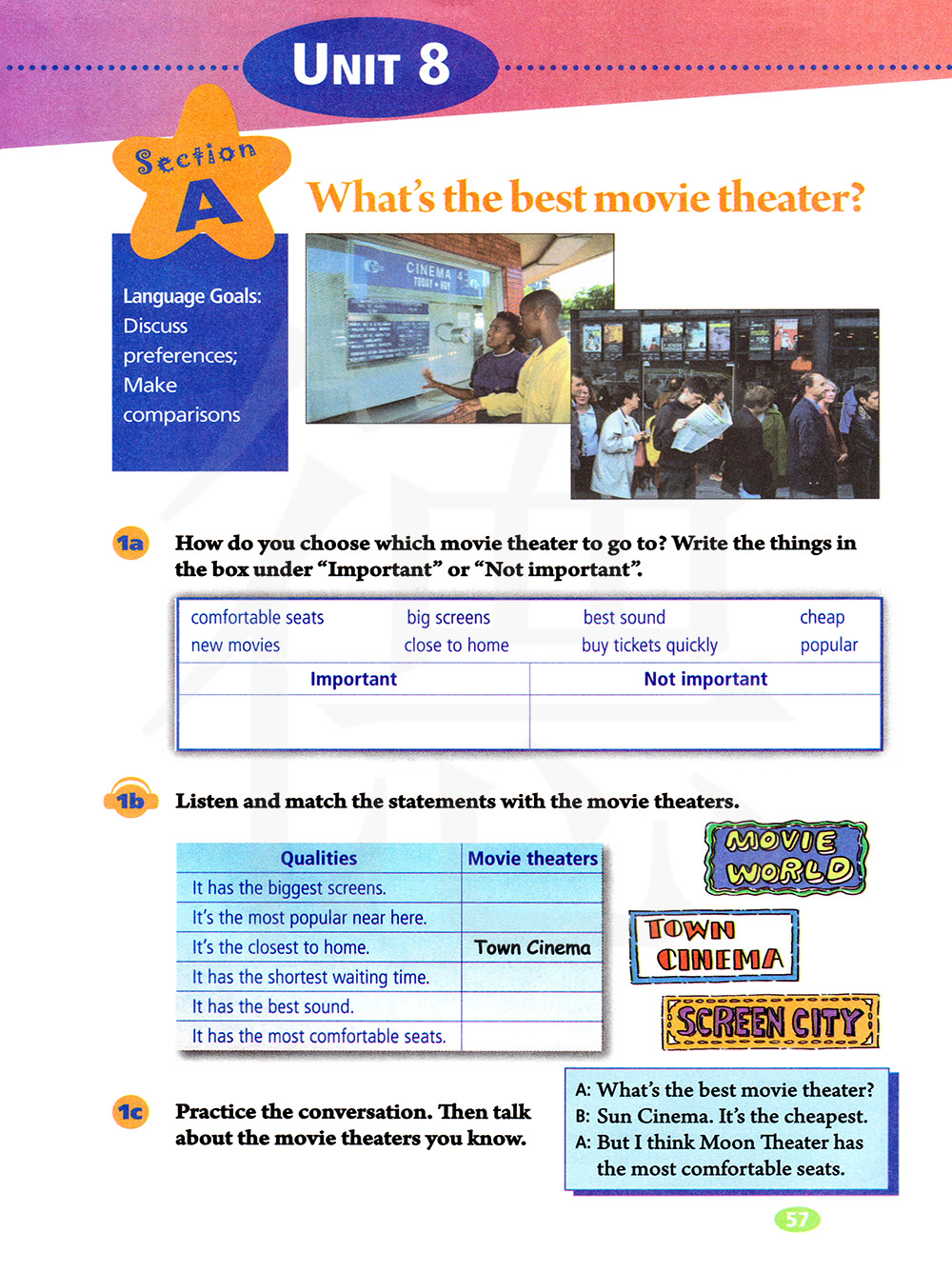
知识点
一、短语归纳
1. movie theater 电影院
2. (be) close to„ 离„近
3. near here 在附近
4. clothes store 服装店
5. in town 在镇上
6. so far 迄今为止
7. no problem 没什么,不客气
8. close to 离..„.近
9. more and more 越来越
10. have„.in common 有相同特征(想法、兴趣等方面)相同
11. be up to 由„...决定/是„...的职责
12. all kinds of „ 各种各样的„„
13. play a role in doing sth./ sth. 发挥作用,有影响
14. make up 编造(故事、谎言等)
15. for example=e.g. 例如
16. take „..seriously 认真对待
17. not everybody 并不是每个人
二、用法
1. How do you like +名/代/V-ing=What do you think of :“ 你认为„怎么样?”
2. Thanks for=Thank you for +名/代/V-ing:“感谢„”
3. You’re welcome. =Not at all. 不客气
4. talent 名(可)天赋 talent show 才艺表演
talented adj. 有天赋的 be talented in 在......方面有天赋
5. be good at 擅长„ (= do well in)
反义短语:be poor / weak in 在...方面薄弱
be good for 对„„有益,后跟人或事物;其反义短语是be bad for
be good to 对„„好(和善;慈爱),相当于 be friendly to,后面通常接
6. all kinds of 各种各样的
different kinds of 不同种类的
a kind of 一种„...
* kind of 有点+ adj.: kind of boring / fat /thin
7. win vt. 赢得+奖品 winner n. 赢者
8. watch sb. do sth. 观看某人做了某事 watch doing sth. 观看某人正在做某事
9. 举例:such as 常列举几个例子,不能穷尽,可和and so on(等等)连用;like可和such as互换;for example 一般只列举一个,作插入语用逗号隔开,可置于句首/句中/句末。
10. Can I ask you some„? 我能问你一些„吗? 三、语法:形容词和副词的最高级 形容词和副词的最高级
1. 用法:形容词、副词有三个等级。
(1) 原级:常用结构as ...as... “像..„„一样”
例如:Zhang Hong is as tall as Tom. 张红和汤姆一样高。
(2) 比较级(用于两者之间的比较)常用结构:形容词比较级+than ... “„„比„„”
例如:He is taller than I. 他比我高。
(3) 最高级(用于三者或三者以上的比较),常用结构:the + 形容词的最高级+of / in ... “最„...”
例如:He is the funniest in his class. 他是他们班最有趣的。
2. 形容词、副词最高级的构成
(1) 规则变化: 构 成 法 原 级 最 高 级
1) 一般情况下直接加-est kind——kindest tall——tallest
2) 以不发音e结尾的单音节词,直接加-st large nice largest nicest
3) 在重读闭音节即:辅音+元音+辅音,先双写末尾辅音字母,再加—est sad——saddest big——biggest hot——hottest
4) 以“辅音字母+y”结尾的双音节词,变y为i+ est. healthy——healthiest lucky——luckiest
5) 以ow, er结尾的双音节词,加—est clever——cleverest narrow——narrowest
6) 其他双音节和多音节词都在前面加most ,difficult——most difficult
(2) 不规则变化
|
原 级
|
比 较 级
|
最 高 级
|
|
good / well
|
better
|
best
|
|
bad / ill / badly
|
worse
|
worst
|
|
many / much
|
more
|
most
|
|
little
|
less
|
least
|
|
far
|
farther(表示距离,译为“更远”)
further(表示程度,译为“进一步的”)
|
farthest
furthest
|
|
old
|
older(表示新旧或年龄)
elder(表示兄弟姐妹的长幼关系)
|
oldest
eldest
|
3. 最高级的句型
【句型1】A+ be +the+形容词最高级+名词+of/in„ 表示“„„是„„中最„„的”
A+ 实义动词 (+the)+副词最高级+of/in„ 表示“„„是„„中最„„的”
表示三者或三者以上(人或事物)的比较,其中有一个在某一方面超过其他几个时,用最高级。形容词最高级前面一般要加定冠词the,副词最高级前的the可以省略,后面可带of/in短语来说明比较的范围。
例如:Spring is the best season of the year. 春天是一年中最好的季节。
This park is the most beautiful of the three. 这个花园是这三个中最漂亮的。
I jump (the) farthest in my class/ of all the students. 我是我们班/所有学生中跳得最远的。
【句型2】主语+ be +one of the +形容词最高级 +复数名词 +in/of短语 表示“„„是„„中最„„之一”
例如:Shanghai is one of the most beautiful cities in China. 上海是中国最美丽的城市之—。
Our city is one of the safest cities in the world. 我们城市是世界上最安全的城市之—。
One of the most important languages is English. 最重要的语言之一是英语。
【句型3】 “特殊疑问词+be +the+形容词最高级+甲,乙,or丙?”
“特殊疑问词+助动词+主语+动词原形(+the)+副词最高级+甲,乙,or丙?”
用于三者以上的比较,意指三个以上的事物或人当中“哪一个(人)最为~呢?”
例如:Which is the biggest of the five apples? 这五个苹果中哪一个最大?
Which season do you like (the) best, spring, summer or autumn? 你最喜欢哪个季节,春天、夏天还是秋天?
【温馨提示】
1. 副词的最高级与形容词最高级的区别在于最高级前没有定冠词the。
例如:He runs fastest of the three. 三个人中他跑得最快。
2. 当用介词短语表明形容词最高级的比较范围,作介词宾语的名词或代词与句中的主语属同一类人或物,并把主语包括在内时,用介词of;如不属于同一类人或物,而只说明在某一时间、空间范围内的比较时,用介词in。
例如:He is the tallest of the four boys. (He 与boy属同类) He is the tallest in our class. (He与class不属同类)
3. 可以用原级,比较级,最高级三种形式来表示最高级的意思。
例如:She is the best student in her class.
She is better than any other student in her class.
No other student in her class is better than she.
No other student in her class is as good as she.