知识点
一、词组归纳
1. in the future 在将来
2. the beginning of 在„„开始时
3. on clear nights 在晴朗的夜晚
4. look at 看着
5. look like 看起来像
6. find out 找出,查明
7. learn about 知道,了解
8. in a lively way 用生动的方式
9. be proud of 为„„感到骄傲
10. more than 多于,超过(over)
11. turn…into… 转变成„„
12. achieve one’s dream 实现某人的梦想
13. on TV 在电视上
14. enjoy oneself 玩得开心
15. grow up 长大,成长
16. next to 靠近
17. all my free time 我所有的空闲时间
18. decide to do sth 决定做某事
19. used to do sth 过去常常做某事
20. be used to doing sth 习惯做某事
21. by the way 顺便说一下
22. make progress 取得进步
23. how often 多久一次
24.give sb sth=give sth to sb 给某人某物
25. give up (doing sth) 放弃(做)某事
26. be interested in sth 对„„感兴趣
27. from that day on 从那天开始
28. dream of (doing) sth 梦想做某事
29.from …to … 从„„到„„
30 one another 彼此,相互
31. all over the world=around the world 全世界
32. come true (梦想)成为现实,成真
33. dress up in +衣服 穿着„„衣服
34. the same …as 与„„一样
35. for a long time 很长时间
36. be well known 非常出名
37. make one’s dream come true 实现某人的梦想
二、课文讲解
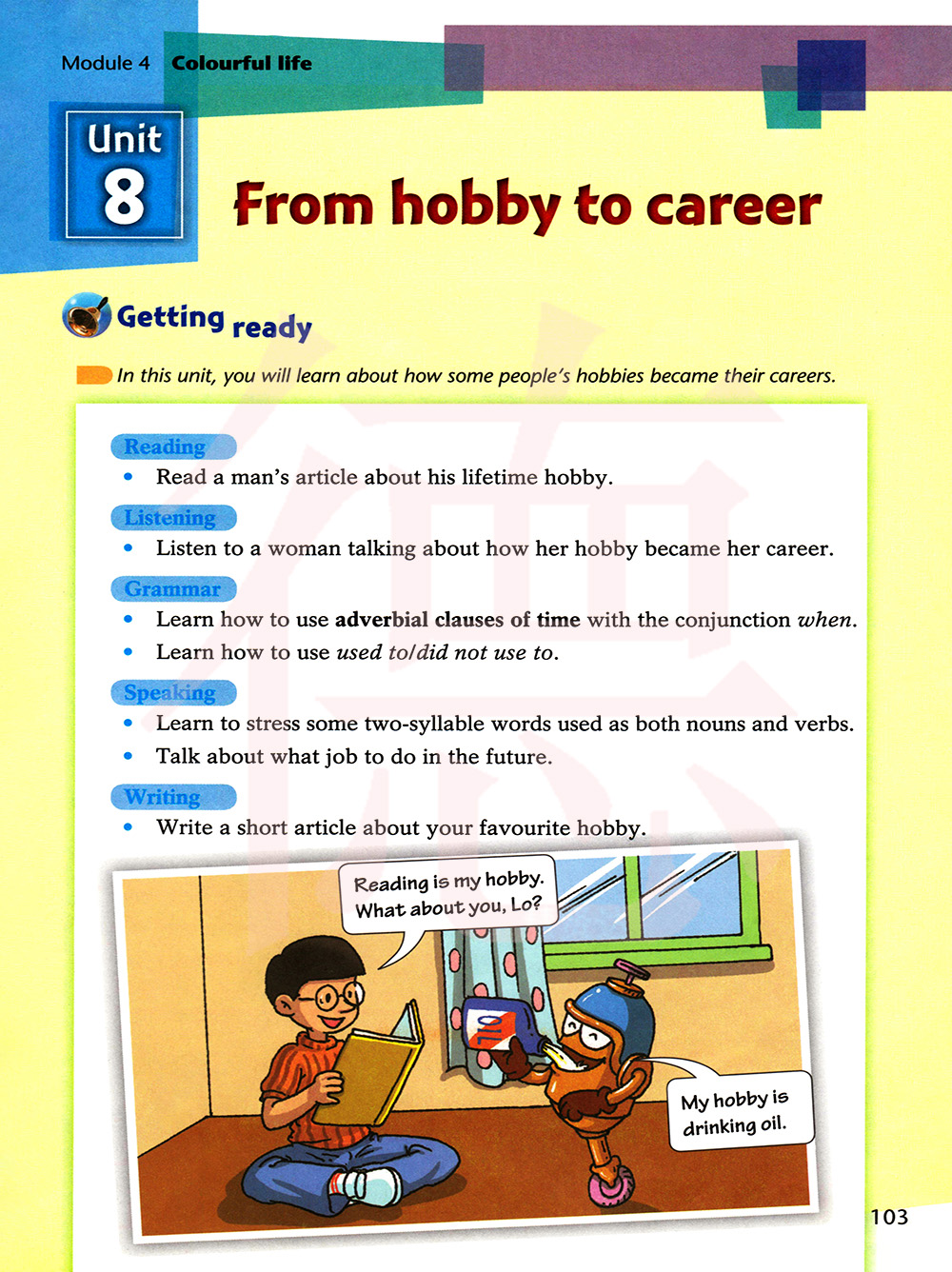
Getting ready
1. hobby 名词,“兴趣,爱好”
Reading is my hobby. =My hobby is reading.
2. Learn to stress some two-syllable words used as both nouns and verbs.学会对既可用作名词又可用作动词的双音节词的重读.
both „ and„ 既„„又„„,„„和„„两者都„„。 谓语动词用复数形式。
Both Lucy and Lily are very beautiful.
neither 指“两者都不”,表示全部否定,作主语时,谓语动词用单数形式。
Neither Lucy nor Lily is right.
3. Talk about what job to do in the future. 谈论未来做什么工作。
(1) job是可数名词,意为“工作,职业” He is out of a job. 他失业了。
(2) work“工作,劳动”,指一般的工作,是普通名词,且作不可数名词。
He is looking for work now and he wants to find a suitable job for him. 他正在找工作,想找一份适合自己的工作。
(3) in the future指从今以后的全部将来。
In the future you’d better get his permission hobby. 今后你最好首先得到他的同意。
4. Write a short article about your favourite hobby. 写一篇关于你最喜欢的业余爱好的小短文。
Favourite 作形容词,“最喜爱的”
favourite 也可作名词,意为“特别喜爱的人或物”,是可数名词。
He is a great favourite. 他是个受大众喜爱的人。
The book is one of his favourite. 这是他最喜爱的书之一。
Reading
1. I used to go outside with my mum on clear nights and look at the sky. 我过去常常在晴朗的夜晚和妈妈到外面去并仰望天空。
(1) used to do sth. 意为“过去常常做某事”,而现在不做了,强调与现在的对比。
He used to get up early. 他过去常常早起。
I used to smoke, but I gave up 2 years ago
(2) be used for doing sth. 被用于做某事。与be used to do sth. 用法相同。
Stamps are used for sending letters.= Stamps are used to send letters. 邮票是用来寄信的。
Wood is used to make paper in the past.
(3) be / get used to + 名词/代词/动名词 意为“习惯于做某事”,其中to是介 词。
Don’t worry, you will soon get used to the noise.
I’m not quite used to the weather here yet. 我还不太习惯这儿的天气。
He gets used to living in the city. 他习惯了住在城市里。
outside外出,反义词是inside.
2. It looked like black velvet with a million diamonds on it. 它看起来像上面镶 有一百万颗钻石的黑色天鹅绒.
(1) look like 看起来像. Lucy looks like Lily. 露西看上去像莉莉.
Look after 照顾 Mary often helps look after her brother.
Look at 看着 Look at the white board, please.
Look for 寻找 I’m looking for my lost pen.
(2) million 百万. two million 2百万 millions of 数百万
It kills millions of birds every year. 每年它杀死数以百万计的鸟.
3. Sometimes we saw stars shooting brightly across the sky. 有时候我们看见星星明亮地划过天空.
(1) some times 几次,几倍 We have been to Shanghai some times.
(2) sometime 用来指过去或将来的一个不确定的时间.
I saw Mr Green sometime in March. 3月份的某个时候我曾见过格林先生.
We will meet again sometime next week. 下周的某个时候我们将再见面.
(3) Some time 一段时间
It will take me some time to draw the picture. 画这幅画将花我一些时间.
4. Once I learnt a little about them, I soon wanted to find our more and more.
1) learn about 了解,学会 He learnt a lot about Chinese history while in China.
2) find/look for/ find out
a. look for 和find 找
look for 强调找的过程和动作 I’m looking for my pen.
b. find强调结果
Can you find the police station on the map?
c. Find out 是指经过调查发现, 查明真相
Let’s find out what we can do for her.
3) more and more越来越
English is becoming more and more important.
5. I host a TV programme called The Sky at Night.
1) host动词,“主持” (hosts、hosting、hosted、hosted)
Apart from my host, I didn't know a single person there.除了主人外,那里的人我一个也不认识。
Tonight she hosts a ball for 300 guests.今晚她做东举办一场有300名客人参加的舞会。
Host 名词,“客人” 拓展:host的反义词 guest 客人; 相关词: hostess 女主人
2) called “被叫做”,动词-ed 形式可表示被动含义。 He is called Tom. I read a book called Old Man and Sea yesterday.
6. I use my knowledge to tell people about the stars in a lively way. 我用我的知识以一种生动的方式让人们了解星星.
(1) knowledge 不可数句词,意为“知识”
We should use knowledge to solve the problems.
(2) lively 形容词,“生动的” (livelier、liveliest)
He made the liveliest speech in class. 他在课上做了一次最生动的演讲。
She was very lively at the stage. 她在舞台上非常活跃。
Her eyes are bright and lively. 她的眼睛明亮有神.
7. I am proud of my TV programme—it has lasted for more than 50 years! 我以我的电视节目而自豪---它已经持续了50多年!
(1) be proud of =take pride in以„„而自豪 His mother is proud of him. 他的母亲因他而自豪。
(2) more than=over “超过” He is more than 50 years old. (3) last 在句中为动词,意为“持续”。
The game lasted for two hours. 这场比赛持续了两个小时。
8. Actually, you can turn your hobby into your career too.
1) actually = in fact “事实上,实际上”, 对前面内容进行总结,解释。
2) turn „ into „= change „into„ 把„„变成„„
9. Anybody can achieve their dreams.
Achieve one’s dream=make one’s dream come true 实现某人的梦想 achieve 动词,“实现”(achieves、achieving、achieved、achieved)
You must work hard to achieve all your goals. 你必须努力实现你所有的目标。
Everyone wants to achieve success. 每个人都想获得成功。
achievement 名词,意思为“成就,成绩”
He graduated with excellent achievement. 他以优异成绩毕业。
10. That sounds good.
Sound 名词,“声音”,指大自然界中的风声,雨声,落叶声,虫叫声等。
sound 连系动词,“听起来”,后接名词,形容词,like介词短语作表语。
That sounds a good idea.
That sounds like the singing of a bird.
11. I kept studying the stars because it was good. Keep doing sth 坚持做„„; 一直做„„
12. His mother spent many exciting moments looking at the stars.
Spend time/ money on sth
Spend time/ money (in) doing sth
I spend 10 yuan on the book.
Listening
1. I decided to leave my job.
Decide 动词,“决定” decide to do sth 决定做某事
Decision 名词,:“决定” make a decision做决定
2. I trained to be a sailing teacher.
1) Train 名词,“火车”
Go to sp by train=take a/ the train to sp 坐火车去某地
He often goes to school by train. =He often take a train to school.
2) train 动词,“训练” Train to do sth 接受训练
He’s training to be a doctor. 他正接受做医生的训练。
Train sb to do sth 训练某人做某事
I often train my students to speak English.
Listening
1. It’ll be really useful for my school project on stars. Be useful for 对„„有用
2. By the way, how’s your project?
By the way 顺便一下
In the/ one’s way 拦路,挡道
On one’s way (to sp) 在(某人去某地的)路上
All the way 一直,总是
In a way 在某种程度上
3. I’m making good progress. Make progress 取得进步 好好学习,天天向上。
4. What do you enjoy doing in your free time?
In one’s free time 在某人的空闲时间
5. Maybe you could become a PE teacher.
Maybe “也许”,副词,做状语,放句首、句中。
May be “也许”,情态动词+be,做谓语,放句中。
6. Do you do it alone or with a group of friends.
1) alone 形容词:“单独的,独自的”
Alone 副词“单独,独自”=by oneself
Lonely 形容词“孤单的,寂寞的”
He is alone.(adj.)
He lives alone.(adv.)
a lonely traveler 无伴的旅行者
注意:alone没有感情色彩,但lonely则表示“孤单、寂寞”的感受。
More practice
1. Never give up.
Give up (doing sth) 放弃(做某事)
2. Jane dreamt of a career studying wild animals in Africa.
①dream (n)梦; I had a dream about my old school.我做了一个梦,梦见了我的母校。
②dream (n)梦想 If I win,it will be a dream coming true.如果我赢了,那就是梦想成真。
③dream (v)做梦 dream of/about梦见;梦想 I dreamt about/ of you last night.我昨晚梦见你了。
3. Jane travelled from Britain go the mountains of East Africa. from„to„ 从„„到„„
4. Jane is now well known all over the world.
1) be well known= be famous “著名的,闻名的”
2) all over the world=around the world “全世界