知识点
词组归纳
1. (not) at all 一点也(不),完全(不)
2. (be ) worried about 为……担忧
3. newspaper stand 报摊
4. rush out 冲出去
5. a crowd of 一群
6. with tired face 带着倦容
7. hurry to work 匆忙去工作
8. change one’s idea (about sth) 改变(对某事的)看法
9. give sb advice 给某人建议
10.take sb’s advice 接受某人建议
11.find out 找出,查明
12.high up in the cloud 高入云层
13.a piece of wood 一块木头
14.all the time 一直
15.in class 在课堂上
16.on a windy day 在一个刮风的一天
17.in a low voice 用低沉的声音
18.leave the door open 让门开着
19.on my way 在我的路上
20 come up 接近,发生
21.follow the rules 遵守规则
22.clean up 打扫
23.knock on the door 敲门
24.from dawn to dusk 从黎明到黄昏,从早到晚
25.keep out city green 保持我们的城市绿色
26.look like 看起来像
27.think of. 认为,想起
课文讲解
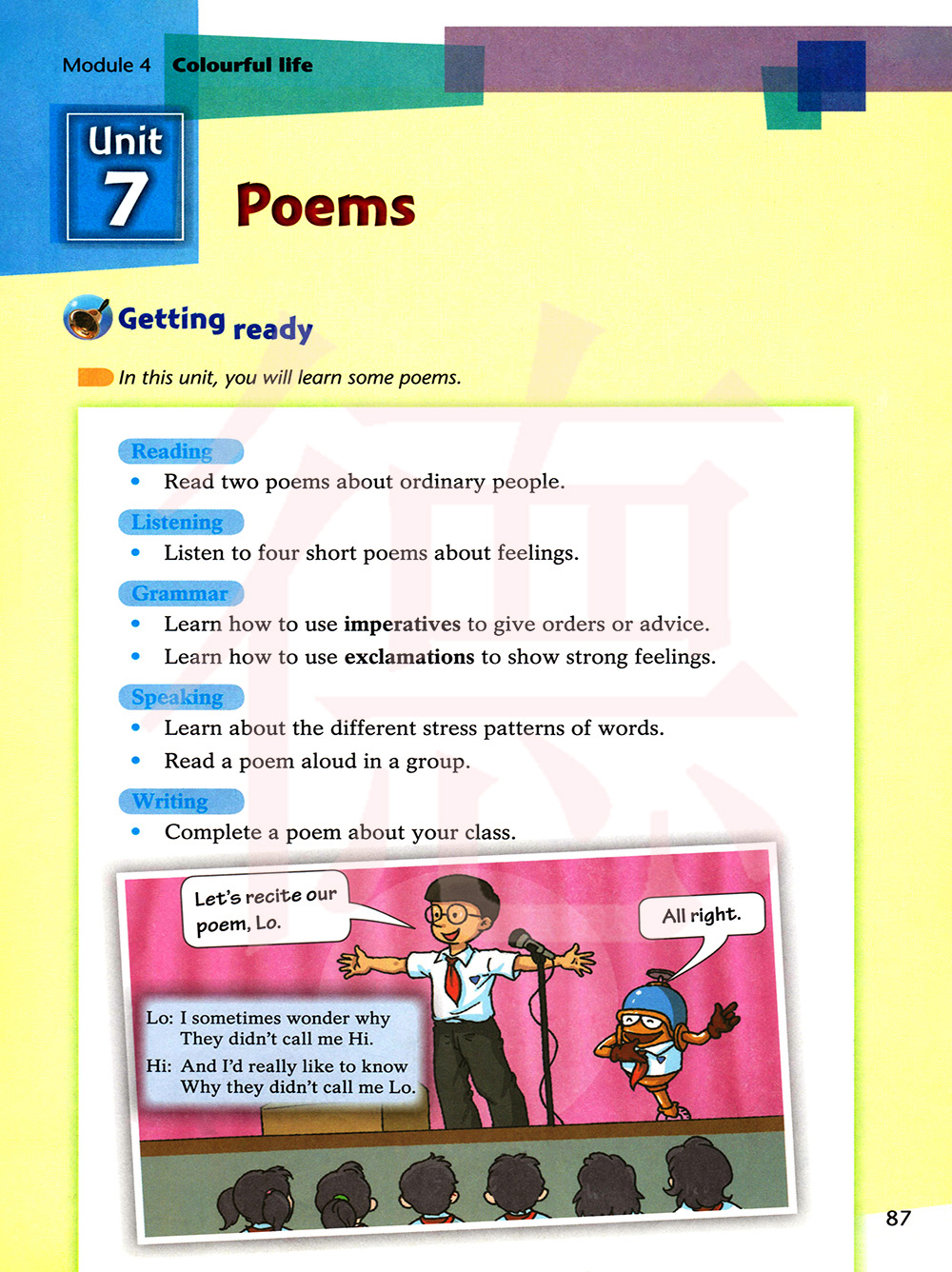
Getting ready
1. Read two poems about ordinary people. 读两首关于普通人的诗歌. ordinary 普通的;平凡的
out of the ordinary 不平常;非凡
2. Listen to four short poems about feelings. 听关于情感的短诗.
(1)feel 连系动词意为”感到,感觉”
I feel very tired today. 我今天感到非常累.
(2)feel及物动词,意为”感觉,触摸”.
I felt the house shake yesterday. 昨天我感到非常累.
3. Learn how to use imperatives to give orders or advice. 学会如何使用祈使句给出命令或建 议.
(1) order 这里用作名词,意为”命令” 也可以是动词”命令”
This is an order. 这是命令.
The police ordered them to wait right there. 警察命令他们就在那儿等候.
(2) order 及物动词, 意为”订购,点菜”
I want to order a ticket. 我想订一张票.
(3) advice 不可数名词,意为”劝告,建议”. a piece of advice 一条建议
The teacher often gives advice to his students. 这个老师经常给他的学生提建议.
4. Read a poem aloud in a group. 在小组里大声读诗.
aloud 副词,意为”出声地; 高声地”.
Please read the text aloud. 请朗读一下课文.
Reading
1. agree to 同意……(意见),to后多接表示计划、建议、安排、决定等的名词或代词。
Do you agree to that plan? 你同意那个计划吗?
2. agree with 同意某人或某人所说的话,with 后常接表示人的名词或代词。
I agree with you in all your views. 我赞成你的一切意见。
3. agree on (两人以上)就„„取得一致意见。
We agreed on a price for the car. 我们商定了这辆汽车的价格。
4. Poems can tell stories. 诗歌可以讲故事。
tell sb. sth. 或 tell sth. to sb. 告诉某人某事。
tell sb. to do sth. 告诉某人做某事。
tell 告诉,后跟双宾语,“讲故事”是tell a story
say 强调“说”的内容 speak 说某种语言
talk 交谈;谈话;谈论 talk to/with sb. 与某人交谈;talk about sth. 谈论某物 5. All poems use complete sentences. 所有的诗歌使用完整的句子。
complete 形容词意为“完整的;整个的”。 动词为“完成”。
6. Water has no taste at all. 水没有一点儿味道。
(1) taste 味道;滋味; 尝起来。
(2) not at all 一点也不; 完全不 It wasn’t difficult at all. 这一点儿也不难。
7. Too tired to laugh or play. 太累了,不笑也不玩。
too „to„ 太……而不能……,可以改写为so„that„句式,so后面接形容词或副词,that 后面接从句,且要用否定式。
She is too young to go there alone. = She is so young that she can,t go there alone. 她太小了,不能独自去那儿。
8. Not worried about the height. 不恐高……
(1) be worried about 为……担忧
Don’t be worried about me. 不要担心我。
(2)height 高度
What is the height of that wall? 那堵墙有多高?
(3) high 高的
How high is the door? 门有多高?
This is a high mountain. 这是座高山。
9. And he’s smiling. 他微笑着。
She smiled at me. 她向我微笑。
laugh表示出声地笑,有时指大笑。 laugh at 嘲笑
10. A bus stops, and the people rush out. 一辆公共汽车停下,人们冲出去。
rush out 冲出去 rush out of „ 冲出……
11. A crowd of people,„ 一群人,……
crowd 作动词为“聚集;挤满” be crowded with 挤满
12. while 连词,意为“在……期间;当……的时候”,引导时间状语从句。
The boy fell asleep while the teacher was having the lesson. 老师上课的时候,这个男孩睡着了。
While the teacher was speaking, the students were listening. 老师讲课时,学生们在听。
1. at the same time 同时
A wide street allows many people to walk at the same time. 宽阔的街道可容许多人同时行走。
2. If you are afraid of heights, you should not work on a building site. 如果你怕高,你不应该在 建筑工地上工作。
(1) be afraid to do sth.
The girl is afraid to go there by herself.
(2) be afraid of sb. / sth.
Many children are afraid of dogs.
(3) be afraid of doing sth.
He is always afraid of making mistakes.
3. find out 弄清楚,查明
4. all the time 一直;始终
The baby cries all the time. at times 不时;偶尔
I make mistakes at times when I speak English.
Listening
1. angry 生气的
(1) be angry with 生某人的气,后接表示人的名词或代词
(2) be angry at/about 因某事而生气,后接表示事物的名词或代词,还可接从句
Don’t be angry with him. He is only a child.
I was angry at/about what he said.
2. excited 感到激动的,指人、物感到激动
exciting 令人激动的,指人、事、物本身让人兴奋、激动
Grammar
1. Please turn off your phone. 请关上你的电话。
turn off 关闭(水源、电灯、煤气等),其反义短语为turn on,意为“打开” turn down 把音量、灯等关小、调低。反义短语为turn up, 意为把音调大。
2.must 一定,必定,表示推测。
You must be hungry after a long walk. 常用于表推测的情态动词:
(1) must 用于肯定句中,表示较有把握的推测,意为“准是,一定”
There must be something wrong. 一定是出了什么差错。
(2) can 常用于否定句或疑问句中,表示惊异、怀疑或不相信等,意为“可能”。
She can’t have done such a thing. Can this be true?
(3) may 用在肯定句中,表示对现在把握不大的推测,意为“可能,也许”。
It may be Bill’s. 那可能是比尔的。
(4) could和might也可以表示推测,might表示的可能性比can和could 要小。
It could rain tomorrow. 明天可能要下雨。
He might be very busy now. 他现在可能很忙。
(5) 表示推测时,can的否定式为can’t,意为“不可能”;may的否定式为may not,意为“可 能不”。
She can’t /may not be there today. 她今天不可能/可能不在那儿。
Writing
1. And they always follow the rules. 他们总是遵规守纪.
follow 动词,意为”遵循;跟从;听从”
Follow the traffic rules. 遵循交通规则。
We should follow his advice. 我们应该听从他的建议。
2. Just knock on the door. 只要敲敲门。
knock on 意为“敲”,常用来表示“敲门、窗”等。
Who is knocking on the door? 谁在敲门?
3. I clean up things that people drop„ 我把人们丢掉的东西打扫干净„„
clean up 清理,打扫