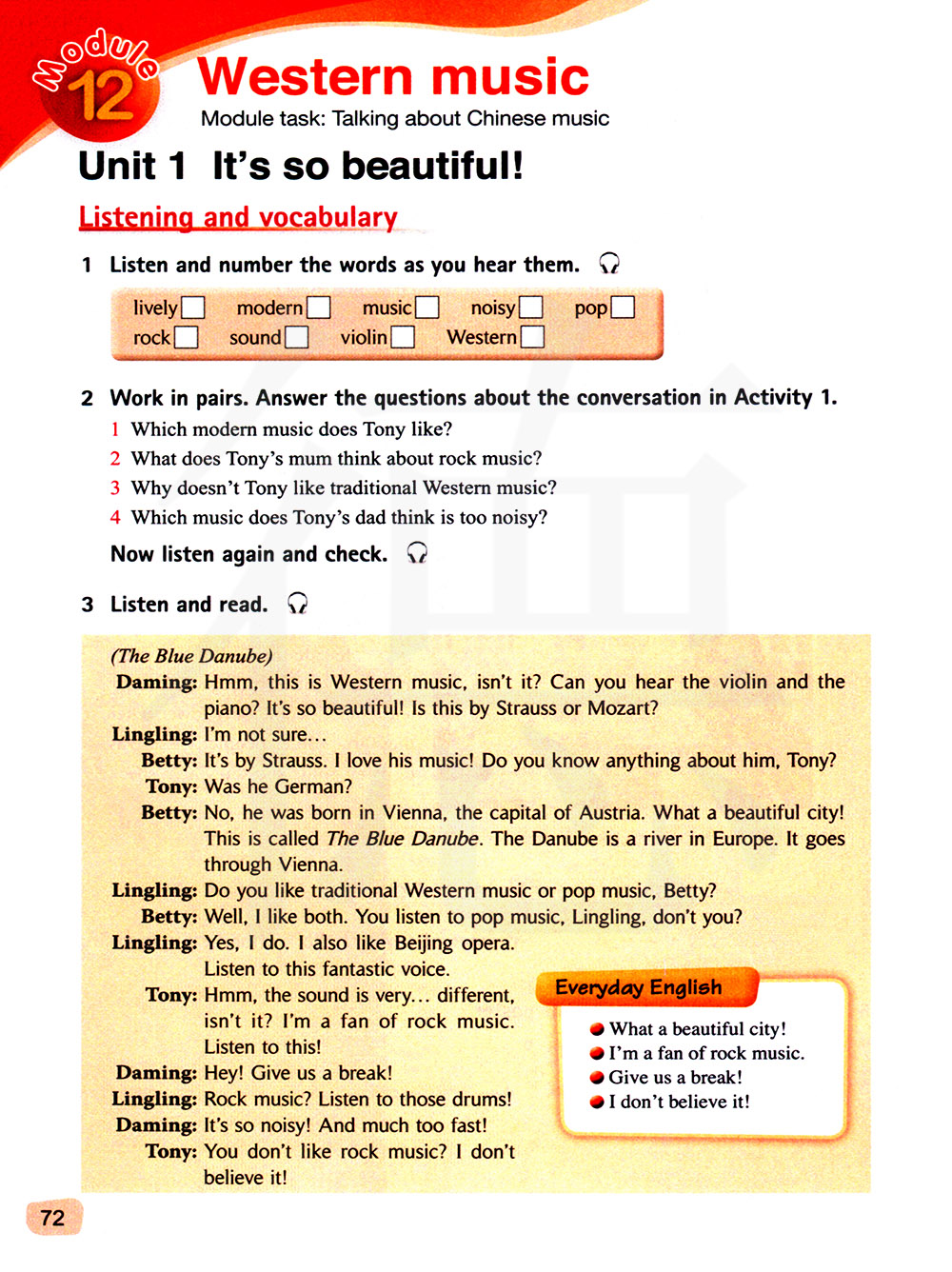
知识点
1、反意疑问句:一个肯定或肯定的陈述句后加上个简短的问句,回答时用yes或no。
1) 前肯后否: --- Tom is a student, isn’t he?
--- Yes, he is . / No, he isn’t.
---She went to the zoo yesterday?
--- Yes, she did. /No, she didn’t.
2) 前否后肯:--- You didn’t go to the party, did you?
--- Yes, I did. (不,我去过。) / No, I didn’t. (是的,我没去。)
2、by 介词,由„创作 I like novels by Lu Xun.
3、I’m not sure. 我不确定。
4、know about 了解 Do you know about the city?
5、the capital of… …的首都 Vienna is the capital of Austria. 维也那是奥地利的首都。
6、be called / named 被叫做/名叫 The boy was called / named Tom.
7、through 介词,穿过,通过,pass / go/walk + through
We had to go through the forest. Light comes in through the windows. 光线从窗户进来。
8、both , all 位于be动词后,行为动词前。Both, all 后都可跟of。 both 两者都 My parents are both teachers. Both of her daughters are doctors.
both A and B A和B都是 Both Peter and Jack like basketball. all三者或三者以上都 The three boys are all from China.
The students in our class all like PE. All of the students in my class like PE.
9、Western music 西方音乐 pop music = popular music 流行音乐 Beijing Opera 京剧rock music 摇滚音乐
10、sound 泛指人们能听到的各种声音, She heard a strange sound.
voice 指人说话或唱歌时发出的声音 The girl has a sweet voice.
noise 指“噪音”,指不悦耳的,令人烦恼的 I can hear the noise from the factory.
11、Give us a break! 让我们清静会吧!(用来阻止别人做令人厌烦的事情)
give/have/take a break 表示“休息一会” have a rest 休息
12、noisy adj. 吵闹的,嘈杂的反义词: quiet 安静的
The classroom is very noisy.
13、much too + 形/副词太 (中心词是too)
This camera is much too expensive. I can’t afford it.买得起
You are walking much too fast. I can’ t catch up with you. 赶上
14、believe sb. 相信某人的话是真的I believe him. = I believe what he says.
Believe in 信任,依赖 Tom is an honest boy. I believe in him.
15、lively与lovely
lively 强调“活泼的,生动的”lovely 强调“可爱的,令人愉快的”
The party was very lovely, and the lively girl had a great time
16、dance to 随着…跳舞 I like dancing to rock music.
17、on the river 坐落于„河畔 The city is on the River Danube.
18、in the centre of„在„„的中心 He lives in the centre of the city.
19、in the 序数词 century 在„„世纪 in the eighteenth century 在十八世纪
20、 The boy called Tom likes listening to music. called Tom 是后置定语,修饰boy。
21、1) elder 年长的,常修饰人,用来表示家庭中有血缘关系的年龄较大的哥哥或姐姐,常作定语,其后不可跟than引导的比较状语从句。elder brother哥哥 elder sister姐姐
2) Older 年龄较大的,较老的,较旧的。常修饰人或物。既可作定语,也可作表语,其后可跟than引导的比较状语从句。
My elder brother is two years older than I. 我哥哥比我大两岁。
22、1) make sb. /sth. + 形容词使某人/某物„ The good news made me very happy.
2) make sb. do sth. 使(让)某人做某事 The manager made the workers work all day.
23、all over 遍及 all over the world 全世界 all over the country 整个国家
all over China 全中国 all over Europe 整个欧洲
24、over = more than 超过,多于 I have over 100 books. = I have more than 100 books.
25、not only…but also… 不但…而且…,连接两个并列的成分,着重强调后者(就近原则)
Not only you but also he likes swimming.
He likes not only Chinese but also English.
26、take sb. around sp. =show sb. around so. 带领某人四处参观某地
Would you like to take /show us around your school?
27、give concerts 举办音乐会 He gave concerts in many cities. go the concert 去音乐会
28、 hundreds of wonderful pieces of music 数以百计的美妙的乐曲
hundreds of 数以百计的(大概数目) two hundred books 两百本书(具体数目)
29、at the same time 同时at that time 在那时
30、play music 演奏音乐
31、traditional music 传统音乐
32、watch it on TV在电视上观看
33、in the last ten years 在过去的十年里
34、lose one’s hearing 失聪,失去听力
35、take place 发生,举行,举办,(非偶然性的)不用于被动语态中。 This story took place last year.
When will the basketball game take place? 篮球赛何时举行?
Happen 发生,碰巧(偶然或突发性事件)
An accident happened in that street.
What is happening outside?
范文:假如你是王飞,是一名中学生,爱听音乐节目。请你给某音乐节目主持人写一 封80词左右的信,信的内容如下:
(1)你喜欢这个节目,尤其(especially)是英文歌曲;
(2)当你疲劳时,你会打开收音机听这个节目;
(3)通过听英文歌曲你学会了很多单词;
(4)你最喜欢听Why did you leave me?这首歌并希望得到歌词(words of the song)。
Dear sir,
I’m a middle school student. I always listen to your radio programme. I like it very much, especially the English songs.
As a student, I’m busy with my lessons. When I feel tired, I will turn on the radio and listen to your programme. I’ve also learned many English words from those songs.
Of all the English songs, I like Why did you leave me? best. Would you please send me the 25 words?