知识点
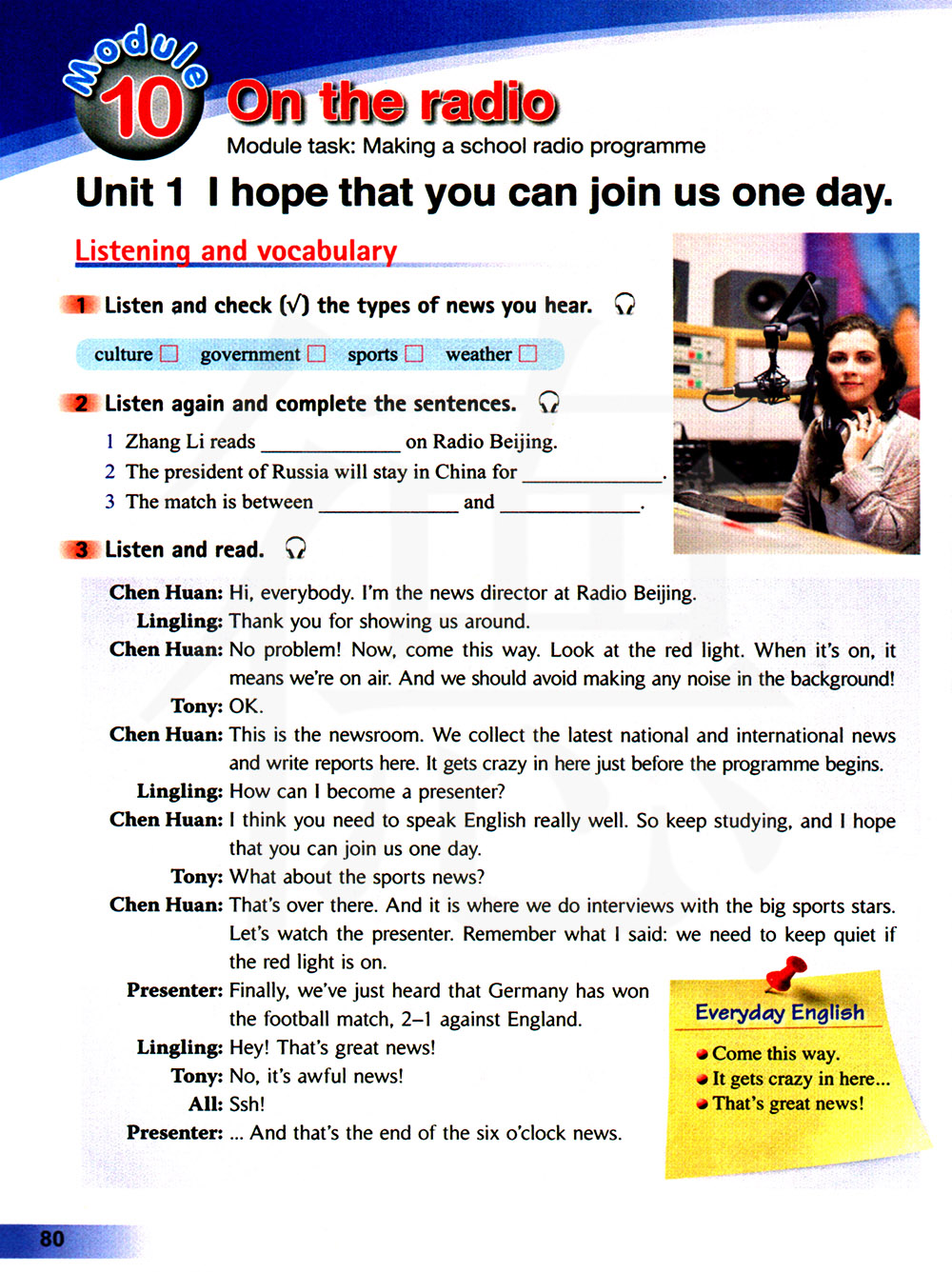
1、Thank you for showing us around. 谢谢你带着我们参观。
Thank you for doing sth. 谢谢你做某事。在该句型for 为介词,后面可跟名词、动名词形式; Thank you也可用Thanks,意为“因......而表示感谢”。
Thank you for helping me with my homework. 谢谢你帮助我做作业。
2、And we should avoid making any noise in the background! 我们应该避免在后面制造噪音!
avoid是动词,意为“避免;防止”,其用法为avoid doing sth.意 为“避免做某事”,其中doing sth.作avoid的宾语。
We should avoid making the same mistake in the future 我们应该避免在将来犯同样的错误。 He avoided answering my questions. 他避不回答我的问题。
后接动词 -ing形式作宾语的动词还有:finish, enjoy, mind 等。
When I finish working out the problem, I’ll go out for a walk. 当我解出这道题,我就出去散步。
3、So keep studying, and I hope that you can join us one day. 那么坚持学习,我希望有一天你们能加入我们。
1). keep是及物动词,意为“坚持”,keep doing sth.表示“不间断地 持续做某事”,强调状态或动作的持续。
Keep running, you will lose the weight. 坚持跑步,你就会减肥。
(1) keep sb. doing sth.意为“让某人一直做某事”。
Don’t keep them waiting for long. 别让他们等很久。
(2)“keep+宾语+宾语补足语”也是一个常考的知识点,其中宾语补足语的成分可以是形容词、介词短语等。
Eating more fruit and vegetables can keep us healthy. 多吃水果和蔬菜会使我们保持健康。
2) hope希望
hope是动词,意为“希望”,hope后可接宾语从句,即hope that...意为“希望......”,that可省略。
I hope (that) I can find a good job after graduation. 我希望毕业后能找份好工作。
hope后还可跟动词不定式,即hope to do sth.,表示“希望做某事”。
I hope to see you in Japan.我希望能在日本见到你。 ”
4、And it is where we do interviews with big stars of sports. 那里是我们对体育大明星进行采访的地方。
where引导的表语从句
where we do interviews with big stars of sports 作 is 的表语。在句 子中作表语的从句叫表语从句。引导表语从句的连词:that, whether;连接代词:what, whatever, who, whoever等;连接副词:when, where, how, why等。从句用陈述句语序。
The problem is when we’ll go there. 最重要的部分是如何到达那里
5、Remember, I said you need to keep quiet if the red light is on. 记着,我说过如果红灯亮着你们需要保持安静。
remember是及物动词,常用短语:remember to do sth.意为“记得去做某事” ;remember doing sth.意为“记得做过某事(此事已经做过)”。
Remember to bring your photos here. 记得把你的照片带到这儿来。
Do you remember seeing the film last year? 你记不记得去年看过这部电影
6、Shouldn’t you be at school? 难道你不应该是在上学吗?
Shouldn’t you do sth.? 难道你不应该做某事吗?
本句是一般疑问句的否定式,意为“难道你不应该是在上学吗?”,表示反问或惊奇。它的肯定回答是“Yes,I should.”意为“不,我应该在学校”,否定回答“ No,I shouldn’t. ”意为“是的,我不应该在学校”。
—Shouldn’t we help the old man? 难道我们不应该帮助那个 老人吗?
—Yes, we should. 不,我们应该帮助。
一般疑问句的否定式句意为“难道……不……;难 道……没有……”,肯定回答中Yes意为“不”,否定回答中No 意为“是的”。
—Isn’t she at home? 难道她不在家吗?
—Yes, she is. 不,她在家。
否定疑问句常用于下列情景:
①表示惊奇。
Don’t you agree? 难道你不同意吗?
②表示感叹,相当于一个感叹句。
Isn’t she tall? 难道她不高吗?(她多高呀!)
③表示责备。
Can’t you see the sign? 难道你没看见这块标志牌吗?
7、It seemed that they were speaking not to lots of listeners but to me in person. 就好像他们没有和许多听众说话而是在亲自和我说话。 1) It seemed that...好像
It seemed that相当于“主语+seem+动词不定式”的句型。本句可改为:They seemed to be speaking......。
It seemed that you are right. = You seemed (to be) right. 你像是正确的。
2)in person亲自
in person是固定短语,意为“亲自”,在句中作状语。
He will come to visit us in person. 他将亲自来看望我们。
8、At the age of nine, I asked for part-time jobs in small radio stations. 九岁时,我去一个小的收音机电台找工作。
at the age of...是固定短语,意为“在几岁时”,后跟基数词,在句中作时间状语,一般和过去时态连用。
Daniel could swim at the age of six. 丹尼尔六岁时就会游泳。
He began to study English at the age of ten. 他十岁时开始学英语。
“at the age of+基数词”也可以用时间状语从句“ when sb. was+基数词+years old”来替换。
He began to study English at the age of ten. = He began to study English when he was ten years old. 他十岁开始学英语。
9、 I did this by looking out of the window. 我通过看看窗外的天气情况做预报。
by是介词,意为“通过”,后接动词-ing形式构成介词短语表示做某事的方式。
We can improve our English by making vocabulary lists. 我们可以通过制作词汇表的方式提高我们的英语水平。
表示方式时,by短语通常有三种形式。
(1) by +v. -ing 形式。
I learn English by making word cards. 我是通过制作单词卡片来学英语的。
(2) by +名词。在此结构中,名词前面不加任何冠词。
Tom often goes to school by bike. 汤姆经常骑自行车去上学。
(3) by+代词。
You can’t win the game by that. 靠那个你是赢不了比赛的。
10、At the end of the show, he closes down all the equipment and goes home. 在节目的最后,他关闭所有的设备回家。
at the end of意为“在......的末尾/尽头”,既可以指一段时间的末端,也可以指地点的末端。
You can visit your grandparents at the end of this year. 今年年底你就能去看望你的祖父母了。
The post office is at the end of the street. 邮局就在这条街的尽头。
11、at the end,in the end 与 by the end
|
词条
|
意义及用法
|
例句
|
|
at the end
|
意为“在……末端/尽头”, 其后常加介词 of,既 可以指时间,也可以指地点。
|
We’ll have an English exam at the end of this month.这个月底我们将参加英语考试
|
|
in the end
|
意为“结果,最终”, 强调最 后的结果, 相当于finally, 其后不能用介词of。
|
They decided to send the sick child to hospital in the end.最后他们决定把生病的孩子送去医院。
|
|
by the end
|
意为 “在……之 前”,后常接 由of引导的短语,表示时间。
|
Anyhow, you must be back by the end of the meeting. 无论如何,你必须在会议 结束之前赶回来。
|
12、When it is on,you have to be quiet. 当它亮的时候,你必须保持安静。
be on意为“进行着;使用着;作用着”。
The lights in the classroom are still on. 教室的灯还开着。
13、It’s+adj. +of sb. +to do sth.表示“某人做某事是......的 ”
句中的it是形式主语,真正的主语是后面的动词不定式。形容词是描述行为者的“性格、品质”的,用of sb.表示。常见的形容词有 careless, clever, foolish, good, kind, nice, polite, selfish, silly, wrong, wise, rude, brave等。
It’s very nice of you to give me a chance. 能给我这次机会,你真是太好了。
It’s+adj. +for sb. to do sth.意为“对某人来说做某事是……的 ”。
形容词仅仅是描述某事物,对某人来说有何影响, 则for sb.表示。常见的形容词有important, necessary, impossible, meaningful, difficult, useful, easy 等。
It’s dangerous for us to play in the street. 在街上玩对我们来说是危险的。
14、agree to do sth.意为“同意做某事”,后跟动词不定式。但不能构成 agree sb. to do sth.结构。
My father agreed to buy a new computer for me.我爸爸同意给 我买台新电脑。
(1) agree to sth.意为“同意,赞成 的观点”,后通常跟表示意见或观点的名词或名词性短语。
Leo agreed to my idea. 利奥同意我的观点。
(2) agree with sb. 意为“同意,赞成某人的观点”,后通常跟人。
The teacher quite agrees with him. 老师相当同意他的观点。
(3) agree on/ about意为“在......上取得一致意见”,主语一般为复数,宾语一般是表示意见或建议的名词、名词性短语或代词等。
We agree on the question. 我们在这个问题上意见一致。
宾语从句的时态问题
一、当主句的谓语动词是一般现在时时,其宾语从句的时态可以是任何适当的现在时态。所以,宾语从句的时态应根据实际 情况而定。
She says (that) she works from Monday to Friday. 她说她从周一至周五上班。(从句是一般现在时)
She says (that) she will leave a message on his desk. 她说她要在他桌子上留个便条。(从句是一般将来时)
She says (that) she has never been to Mount Emei. 她说她从来没有去过蛾嵋山。(从句是现在完成时)
二、当主句的谓语动词的时态是一般过去时时,其宾语从句的时态一般要用任一适当的过去时态。
He said there were no classes yesterday afternoon. 他说昨天下午没有课。(从句是一般过去时)
He said (that) he was going to take care of the baby. 他说他会照看这个婴儿。(从句是过去将来时)
He said (that) they were having a meeting at that time. 他说他们那时正在开会。(从句是过去进行时)
三、当宾语从句是表达客观真理和规律的句子时,无论主句是何种时态,从句用一般现在时。
The teacher told us (that) nothing is difficult if we put our hearts into it. 老师告诉我们世上无难事,只怕有心人。
He said that light travels much faster than sound. 他说光比声音传播得快。