知识点
1. experience n.经历(可数) 经验(不可数)
v 经历;感受 adj. experienced 有经验的
Eg: He is a teacher of much of teaching experience. 他是一位有很多经验老师。
He had many interesting experiences in Beijing.他在北京有许多有趣经历。
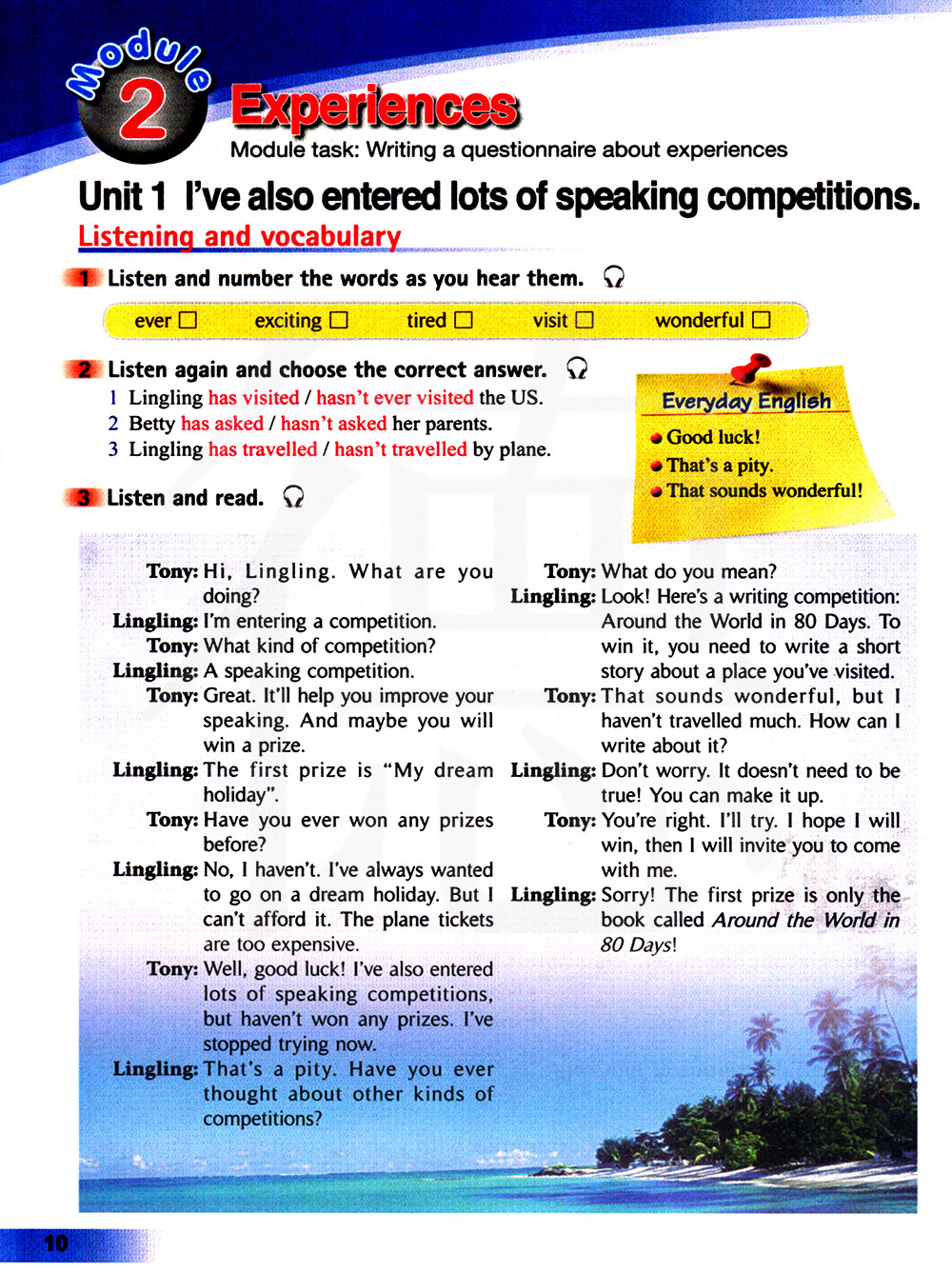
2. enter a competition=take part in a competition参加比赛
have a competition 举行比赛
同义词辨析:
contest意为“比赛,角逐,竞争”,如:a beauty contest 选美比赛;match/game多指(足球、棒球、篮球)比赛,如:football/baseball/basketball match/game。
3. win a prize获奖Eg: I won a prize for running. 我跑步得了奖。 They got the first prize. 他们得了一等奖。 win+奖品/奖金/比赛 “赢得…” beat/defeat+人/队伍 “打败…”
4. dream come true梦想成真
Eg: My dream will come true one day.我的梦想总有一天会成真。
同义词辨析:come true的主语必须是物,不能是人; achieve 实现,主语必须是人,如:
My dream has come true.=I have achieved my dream.(我的梦想已经实现了。)
dream of/about… 梦见…/梦想…(可接sth或doing)
She dreamed about her baby.她梦见了她的宝宝。
5. afford v.意为“(有财力)买得起;付得起”,其后可直接跟名词或代词作宾语。
Eg: The car is very beautiful. But it’s too expensive. I can’t afford it. afford to do sth. “负担得起做某事”。afford常常和情态动词can’t和couldn’t连用,用在否定句中。
6. good luck祝你好运 luck lucky luckily
7. stop doing sth.停止做某事 stop to do sth.停下来去做某事
Eg: The two girls stopped talking when they saw me. 那两个女孩一见到我就停止说话。
The two girls stopped to talk to me when they saw me. 那两个女孩一见到我就停下来和我说话。
stop sb. (from) doing sth.阻止某人做某事
Eg: Liming’s father stops him from playing computer games.
8. That’s a pity! = What a pity! = It’s a pity! 真遗憾
9. one of the +形容词的最高级+可数名词复数,意为“……(中)最……之一”,短语中需要特别注意两点:
① 形容词的最高级之前必须有定冠词the。
② 名词必须是复数。在短语之后常常会跟一个表示比较范围的短语。
Eg: The hens are one of the most useful animals in the world. 母鸡是世界上最有用的动物之一。
当“one of the+形容词的最高级+可数名词复数”作主语时,谓语动词要用单数。
Eg: One of the cleverest students in our class is from our village. 我们班最聪明的学生之一来自我们村子。
10. a lot后面不接名词时,不用加of, 这时常表示 “非常” “很多”
I love English a lot. I’ve leant a lot from him.
11. worry about me=be worried about me担心我 worry me使我担心
12. make up编造,编写
Eg: The whole story is made up. 整个故事是虚构出来的。
13. hope 1) to do sth. 2) (that) +宾语从句,表示可实现的愿望。
Eg: He hopes to see you next week. /I hope that I can finish my homework in an hour.
14. invite sb. to do sth.邀请某人做某事 invitation(n.)邀请,请柬 Eg: She invited me to go fishing last week.
15. Although, Though “尽管”, 不能与but一起使用
16. Mike is a fifteen-year-old American boy.
“数词-名词-形容词” 或 “数词-名词”
1) 相当于一个形容词
2)结构中的名词用单数
3)后面要加一个名词
17. at the moment现在,此刻 18. work for为…工作
19. the +姓(复数) 或 the+姓+family 表示 “姓…的一家人”, 尤其指夫妻二人, 当成复数看
20. for example 例如(列举一个例子) such as 例如(列举多个例子)
21. be different from与…不同 the same as与…相同
22. They found it hard to spell and pronounce the words. (it形式宾语)
It is hard to spell and pronounce the words. (it形式主语) 只有it可以充当形式主语/宾语, 真正主语/宾语用to do
23. so far=up to now=up till now “到目前为止”, 与现在完成时连;
24. mix混合 mix sth. into… 把…加到…里 mix…with…把…和…混合
25. count down (from…) 从…倒数 Eg: You can count down the days to freedom. 你可以算出离自由的日子还有几天。
26. how 的常用搭配:
(1) 多久,多快;对表示将来时间提问 She will come back in five minutes.How soon will she come back?
(2) 多久一次;对表示频率进行提问 She visits her grandma once a week.How often does she visit her grandma?
(3) 多久,多长;对时间长短或物体长度提问She has lived here since 2001/for twenty years.How long has she lived here?
(4) 多远;距离提问 how far
(5) 多少;对数量提问 how much/ many
27. look forward to doing sth.期待做某事 expect to do sth.期待做某事
28. have a wonderful time =have a good time = have a great time =enjoy oneself=have fun 过得愉快
29. another意为“又一个,另一个”,其后只能跟单数名词,常用于三者或三者以上,指不确定数目中的“另一个”。
Eg: He drank another glass of beer. 他又喝了一杯啤酒。
(1) 当another作“再„,又„”讲时,即“another+ 数词+名词复数形式”=“数词+more+名词复数形式”。
Eg: another ten chairs = ten more chairs.
(2) the other指两者中的“另一个”,通常与one搭配使用,构成 one…the other…“一个, 另一个”
Eg: His parents both work in a hospital. One is a doctor, the other is a nurse. 他父母都在一家医院工作。一个是医生,一个是护士
语法:现在完成时
1. 定义:
(1) 现在完成时表示一个过去发生并结束的动作对现在产生的结果和影响;以 一个数轴来表示理解。已完成用法=影响性用法
Eg:I have had lunch.
(2) 表示过去某个时间开始的动作或存在的状态,一直持续到现在并可能还将 继续下去。未完成用法=持续性用法
Eg: She has taught in this school for 3 years.
2. 基本结构:
(1)肯定句:主语+have/has+动词的过去分词+其他
(2)否定句:主语+have/has+not+动词的过去分词+其他
(3)一般疑问句:have/has+主语+动词的过去分词+其他
Yes, 主语+have/has. No , 主语+have/has+not
(4)特殊疑问句:特殊疑问词+have/has+主语+动词的过去分词+其他
Eg: I have read the book.
Eg: I have not seen him before.
Eg: Has this book been returned to the library. Yes, it has. No, it has not.
Eg: Where have you been in China?
3. 动词的规则变化:一定要去理解; 动词的不规则变化:一定要去背诵;英语课本有,不一一列举出来。
(1)规则变化
动词过去分词变化规则与不规则变化(一)变化规则:与过去式规则相同。
a. 一般直接在词尾加上ed。look---looked----looked
b. 以e结尾的动词,直接加d。move---moved----moved
c. 以y结尾,y前面是辅音字母的动词,变y 为i,再加ed。carry---carried-----carried
d. 部分动词需双写尾字母,加ed。stop----stopped----stopped
(2)不规则变化 (见不规则动词表)
4. 用法:
(1) 常与表示不确定的时间状语连用recently, just, already, yet(否定), before,lately等连用; 与频率的时间状语连用,ever, never, twice, on several occasions; 与“现在”的时间状语连用,today,now, this morning\month\term\year
Eg Li ming has just turned off the light.(说明现在灯已经关上了)
I’ve already finished my homework now.(说明可以交作业或作别了)
记住:过去具体何时发生不重要或者已经忘记了。属于现在时态范围,因此不能表示过去的时间状语连用,如yesterday, last Sunday等
(2)表示过去某个时间开始的动作或存在的状态,一直持续到现在并可能还将继续下去。动词使用延续性动词。For+段时间; since+点时间; since+句子(过去时)
Eg. I have lived here for 3 years.
I have lived here since 3 years ago.
I have lived here since I came to Huizhou.
记住:当现在完成时与表示短时间的时间状语连用时,谓语动词必须使用延续性动词。如果谓语动词是非延续性动词则转化为对应的延续性动词。 若不是和短时间连用,则不用转化。
英语的行为动词有持续性动词和瞬间性动词之分,使用中应注意两者的区别。
1) 持续性动词: 表示一个动作可以持续一段时间或更长时间。常见的study, play, do, read, learn, drive, write, clean , sleep, speak, talk, wait, fly, stay, sit, stand, lie, keep等。
2) 瞬间性动词: 表示一个动作发生在一瞬间,非常短暂。亦称终止性动词。 常见的--begin, start, finish, go, come, leave, find, get up, arrive, reach, get to, enter, hear, stop, open, close, become, buy, borrow, lend, happen, join, lose, renew, die, take away, put up, set out, put on, get on/off等。
3) 瞬间性动词在完成时中如要与表示持续一段时间的状语连用,通常用意思相 当的持续性动词来替换
4) 常用的非延续动词:die, arrive(到达),join(加入),leave(离开), go, refuse(拒 绝),fail(失败),finish,buy,marry,divorce(离婚),awake(醒) ,buy,borrow,lend ...(背三遍!)
注意:这类动词并非不能用现在完成时,而是不能接常由for引导的时间状语
1、go—be away 2、come—be here 3、come back—be back 4、leave—be away(be not here) 5、buy—have 6、borrow—keep 7、die——be dead 8、begin——be on 9、finish—be over 10、open——be open 11、close——be closed 12、lose——be lost 13、get to know—know 14、turn on—be on 15、get up——be up 16、sit down—sit/beseated 17、join—be in(…)或be a…member 18、become—be
(3)It is\ has been +段时间+since从句;段时间+has passed+since从句。 Eg. 他住在这里两年了。 He has lived here for two years \ since two years ago. It is \ has been two years since he died. Two years has passed since he died.
(4)区别下面三组词
1)Have\ has gone to sp. 已经去了或在途中,还没回,着重指人不在,只限用第三人称。
Eg: Miss Li isn’t here. She has gone to New York.
2)Have\has been to sp.曾今去过某地,现已经回来了,后面接次数的状语
Eg: She has been to China 3 times.
3)Have\has been in sp. 表示”呆在某地”,某人已在某地停留一段时间,现在仍在那里,或“加入”组织和团体,其后常常表示一段时间的状语。
Eg:He has been in the Party for 1 year.