知识点
1. be tired of 对……厌烦
2. make peace with…与……讲和
3. consider +n./pron./doing考虑做某事
consider…as…把…看作…
consider+宾语+宾补 把…当作…
We consider her as our best friend.
4. be fascinated by 被……吸引住
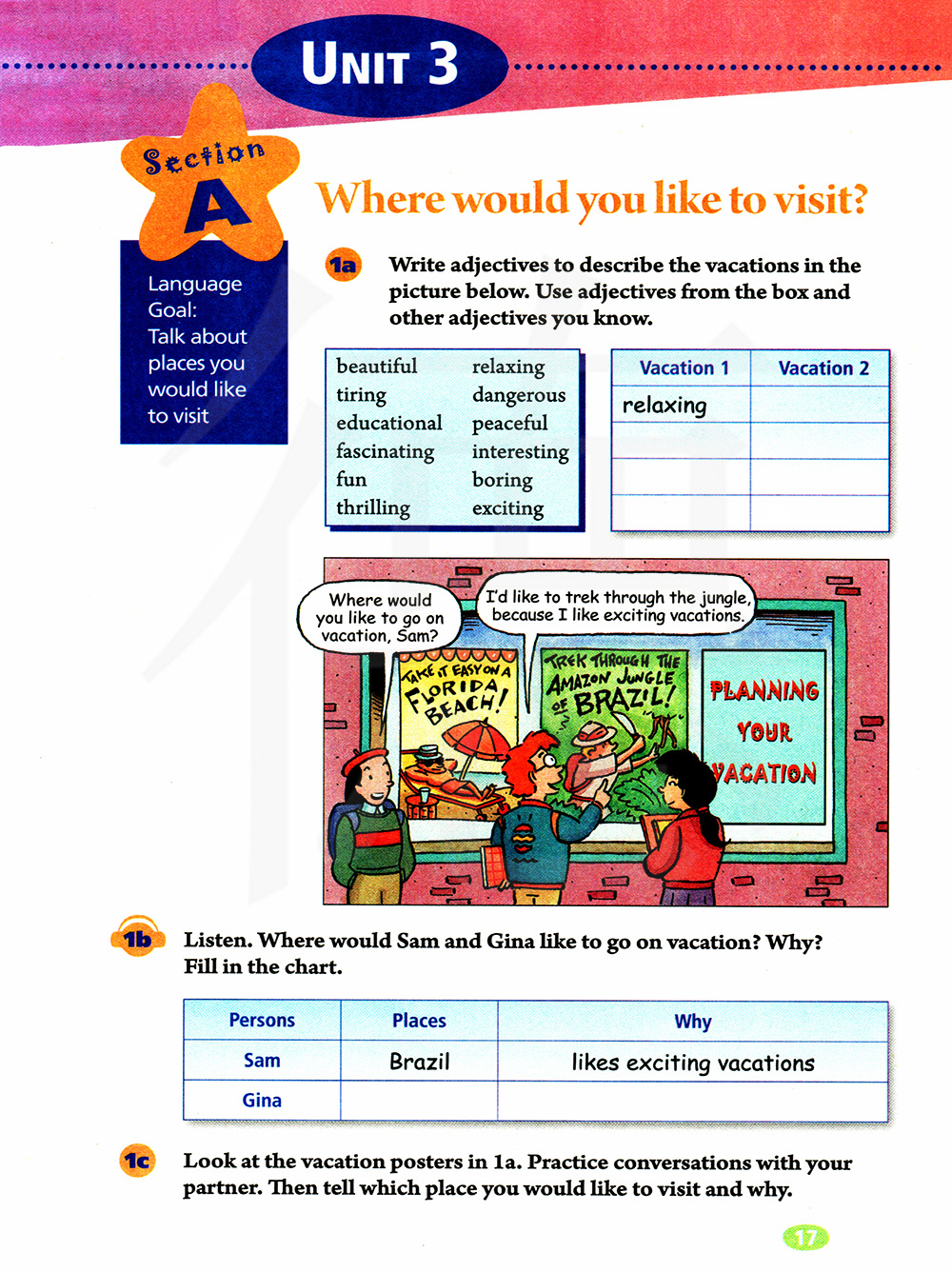
5. trek through jungle 穿越丛林
6. fall behind 落后 fall off 跌落,掉下 fall down 跌倒 fall out 掉落,脱落
7. some day 有一天,总有一天。指将来的某一天,只用于将来时态。
one day 有一天,可指将来或过去的某一天,可与将来或过去时连用。
8. match…with…把。。。与。。。搭配
9. somewhere relaxing形容词修饰不定代词或某些地点副词(something, anything, nothing, anywhere, somewhere, nobody)等时,应后置。
10. relaxing 令人放松的,修饰物。 Relaxed 感到放松的,修饰人。
11. one of the liveliest cities最有活力的城市之一,one of +the+形容词+名词复数形式,固 定结构,最。。。之一。
12. be supposed to do/be sth (按规定,习惯,安排等)应当、应该做某事。
be not supposed to do sth.不允许或禁止做某事
13. would like/love+n./pron./to do 想要(做)某(物)事
14. on vacation 在度假 on表示“处于某种状态”。On business 出差 on sale 打折 on duty 值日 on fire 着火 on a visit 在访问
15. through 介词,从。。。中间通过,着重空间内部穿过
across 介词,穿过。着重指从一条线或物体表面穿过。
16. Why not do…?=Why don?t you do…?为什么不。。。?用来提出建议的句型还有:
Shall we do…?
How/what about doing…?
Let?t do…?
17. cost 花费,事或物做主语。
spend time/money on sth(主语为人)
spend time/money (in)doing sth
It takes sb. some time to do sth. pay money for sth(主语为人)
18. in general 通常,大体上。
19. translate sth for sb 为某人翻译某物
translate…into…把。。。翻译成。。。
20. provide sb with sth=provide sth for sb 为某人提供某物
offer sb sth=offer sth to sb.向某人提供某物
21. else adv.别的,其他的。它通常放在疑问代词、不定代词和疑问副词之后。Would you like something else to drink?
22. take a message for sb给某人捎口信 leave a message 留言 send short message 发短信
23. take a trip=have a trip=go on a trip去旅游
24. be away离开,表示状态,可与段时连用。
put away 把。。。收起来 take away 拿走far away 远离
pass away 去世 stay away from 与。。。保持距离
25. agree on sth 就某事达成一致意见
gree with sb 同意某人的意见,与某人意见一致
agree to 同意(某个计划或方案)
26. mind doing sth介意做某事
mind my/me doing 介意某人做某事
27. give sb some suggestions=give sb some advice给某人一些建议。
28. hope to do sth/that从句
wish to do sth/sb to do sth/that从句
29. need do sth (need为情态动词)
need to do sth(need为实义动词)需要做某事,主语为人
need doing sth 主语为物,某物或事需要被做。(主动形式表被动意义)
need sth(名词或代词) 需要某事或某物
30. If I were there…如果我去那的话。。。。。。(虚拟语气)
If I were you, I would help him at once.
这种句子里含有虚拟语气的条件状语从句,叫虚拟条件句。表示与现在的事实相反,从句的谓语动词用过去式(若为be动词,一律用were),主句的谓语动词可用would/should/could/might+v原形。
If I were you, I would go there with her..
31. dream about=dream of 梦想,梦见。。。。。。
32. 人+achieve/realize +梦想、理想(某人实现梦想)
梦想、理想+come true(梦想实现)
33. in the future 将来,指将来的时间,含有与过去或现在对比的意味。 in future 今后,指从说话时开始的将来,可用在含有劝告或警告意味的句子。Don?t be so careless in future.
34. take part in指参加某一活动,并在其中起积极作用。
He often takes part in after-school activities. attend 出席(会议),到场,上课,侧重于去看或去听。
He has decided to attend the meeting.
join 侧重指参加或加入某个党派、团体、组织并成为其中一员。He joined the League two years ago.
join in 用于参加某种活动,相当于take part in ,但take part in 更强调“参与性”。
35. answer to the question 问题的答案
the notes to the text 课文的注释
the key to the door 门上的钥匙
36. continue doing sth =continue to do sth=go on doing sth 继续做某事,不停地做某事。
37. according to…根据,按照,据。。。所说
38. quite a few(=many)相当多,不少 quite a little(=much)
39. be willing to do sth 愿意做某事
40. on (the) one hand…on the other hand 一方面。。。另一方面。。。 41. hold on to 坚持。。。,不要放弃。。。;抓住,抓牢。
42. be different from… 与。。。不同
be the same as…和。。。一样
43. 辨析find out/find/look for
Find out指通过调查,询问,打听,研究之后搞清楚,弄明白,通常指找到无形的,抽象的东西。
Find强调“找”的结果,通常指找到具体的东西,也可指偶然发现某事或某种具体情况。
Look for 强调“找”的动作,指有目的地找。
He looked for his pen everywhere, but he couldn?t find it. He hasn?t find out who took it away.
44. It seems some students would like to start work as soon as possible, so that they can help provide better lives for their parents.
It seems/seemed that…似乎、看起来好像。。。。。。通常用于根据见到的某些迹象推断出结论的句子
So that 以便,为了。引导一个目的状语从句,相当于in order that…。So that 引导的目的状语从句中常会含有can, could, be able to 等情态动词。
He bought a digital camera online so that he could save a lot of money.
语法解析:
动词不定式的用法:
动词不定式由“to+动词原形”构成。若to do中的动词do 带有其他成分,如宾语或状语,则叫不定式短语。不定式或不定式短语在句子中可作主语、宾语、表语、定语、状语和宾语补足语。
|
功能
|
说明
|
例句
|
|
主语
|
不定式(短语)作主语时,常用it作形式主语,而把真正的主语即不定式(短语)放在后面。
|
It will take us two hours to go there by bus.
|
|
表语
|
不定式(短语)作表语通常说明主语的内容,多数情况下,可换为主语。
|
Her dream is to be a teacher.=To be a teacher is her dream.
|
|
宾语
|
只能作某些动词的宾语,一般不作介词的宾语。
|
My parents decided to buy me a new computer.
|
|
宾补
|
在see, watch, hear, make, let等感官、使役动词后作宾补时,省略不定式符号to(在被动语态中则需还原to);而在动词ask, tell, like等后作宾补则必须带to.
|
He always hears her sing in her room. He was made to cry for a long time. My mother asked me to go home early.
|
|
定语
|
不定式(短语)作定语,要放在所修词的后面。
|
Let „s find a more comfortable house to live in.(不及物动词后需跟出相应的介词。)
|
|
状语
|
不定式(短语)作状语时,表示目的等,其逻辑主语要和句子的主语保持一致。
|
To keep healthy, you „d better do some running in the morning
|