知识点
短语归纳
1. the day after tomorrow 后天
2. go to the doctor 去看病
3. have a piano lesson 上钢琴课
4. have to 不得不
5. text time 下一次
6. study for a test 准备考试
7. come oner in an hour 在一小时后顺便来访
8. keep quiet 保持安静
9. Please write soon 请一会儿回信
10. be free 是闲的
11. go to the concert with me this evening 今天晚上跟我去参加音乐会 study for a chemistry test tomorrow 明天为化学考试学习
12. go to the docter / dentist soon 一会儿去看医生或牙医
13. help my parents on weekdays 在工作日帮助我的母亲
14. visit my aunt on weekend 在周末看望我的阿姨
15. play soccer until three o’clock 在三点以前踢足球
16. go to the mall in thirty minutes 在三十分钟后去购物中心
17. finish my chemistry project 完成我的化学作业
18. thank you so much for you invitation 非常谢谢拟邀请
19. come to my party next week 下一周来参加我的聚会
20. have a piano lesson soon 一会儿上钢琴
21. try to study chemistry努力学习化学
22. babysit her sister 照顾他的妹妹
23. have tennis training 有网球训练
语法知识
1. have to 与情态动词的区别
情态动词不能单独作谓语,后面必须接动词原形一起构成谓语,have to 也是这样。
情态动词没有人称和数的变化,而且所用的时态也受到一定的限制,但是have to 有人称和数的变化,可用于多种时态中,在一般现在时中,当主语是第三人称单数时,要用has to, 其余人称用have to;一般过去时中用had to;一般将来时中用will have to, 例如:
She has to go to school by bus. 她不得不乘公共汽车去上学。
If you get ill, you'll have to see the doctor. 如果你生病的话,你就得看医生。
2. have to 与must 的区别
have to 和must 都有“必须”的意思,那么它们 有哪些不同呢?
(1) 含义和用法上的区别:
have to 强调客观上需要做某事,即表示外界条件的需要不得不做某事,含有“形势逼迫”的意味;must 强调说话者主观上认为必须做某事,含有“主观判断”的意味, 例如:
My bike was broken on my way to school. I had to walk there. 我的自行车在上学的路上坏了,我不得不走路去上学。
(我本来不愿意走路,可是自行车坏了,不想走路也不行。) We must learn English well. 我们必须学好英语。(主观上有这种想法。)
(2) 否定式的区别:
have to 的否定式 意为“不必”,must的否定式意为“禁止;不允许”。因此,以must开头的一般疑问句的肯定回答为“Yes, 主语+must”,否定回答为“No, 主语+needn't / don't have to”。例如:
---Must I finish the homework now? 我必须现在完成作业吗?
---Yes, you must. (No, you needn't / don't have to) 是的,你必须现在完成。(不,你不必。)
3. 反意疑问句的构成区别:
(1) 陈述部分含有have to 时,其附加问句的谓语往往用助动词do的相应形式或助动词will。例如:
You had to g o shopping yesterday, didn't you? 昨天你不得不去购物,是吗?
(2) 陈述部分含有must 时,其附加问句的谓语,按下面几种情况来确定:
A. must 意为“必须”时,附加问句谓语用needn't。例如:
We must clean the room, needn't we? 我们必须打扫房间,是吗?
B. mustn't意为“禁止”之意,附加问句谓语用must。例如:
The boy mustn't play with the knife, must he? 那个男孩不能玩刀子,对吗?
C. must 意 为“应该”时,附加问句谓语用mustn't。例如:
We must help each other, mustn't we? 我们应该互相帮助,对吗?
D. must 意为“一定;想必”表示推测时,附加问句部分谓语要根据must后面的动词来 确定。例如:
Mr Wang must be at home, isn't he? 王先生一定在家,对吗?
注:
must 表示的是一种相当肯定的与事实非常接近的推测。例如:
Mr Wang must be at home. 其实就相当于Mr Wang is at home.
因此,它的反意疑 问句的附加问句部分是isn't he 也就很容易理解了。 又如:
They must be right, aren't they?
知识归纳
1、else , the other , others , another 区别:
(1) else “别的 其他的 另外的” :修饰 who、 what 和“复合不定代词” , 且放在所修饰词之后。(注意:else不修饰名词)
①----What else do you have to do ? 你们还得做什么?
----We have to clean the classroom . 我们必须打扫教室。
②----Who else is you visiting ? 你还打算拜访谁?
----I am visiting Mr Zhang . 我打算拜访张先生。
③There isn’ t something else . Let’s go home . 没有别的事情了,我们回家吧。
(2) the other “另一个” , 特指“两者”中的“另一个” ,常与one 连用,即:one…… the other …… “一个„„另一个„„”
①、We have two matches . One is a basketball match , the other is a football match .
②、The other invitation is Miss Wang’s . 另一个邀请是王小姐的。
(3) others “另一些” , 常与some连用,
即:some…… others ……“一些„„另一些”
例如:There are a lot of children here . Some are playing soccer , others are studying for a test . 这儿有许多孩子,一些正在踢足球,另一些正在为考试学习。
(4) another “另一个,再一个” ,有两个用法:
①、笼统地指“多个对象”中的“另一个” ,并不具体指明哪一个
②、“another + 基数词+名词” 表示:“再几个„„,又几个„„”
1)、I have four calendars , but I still want another . 我有四个日历,但是我还要一个。
2)、I don’t like this pen , please show me another . 我不喜欢这支钢笔,请给我看另一支。
3)、Let’s go to another shop . 让我们去另一个商店吧。
4)、 I want another four calendars . 我还要四本日历。
5)、The reporter wrote a story . She wants to write another two stories . 这位记者写了一个故事,她想要再写两个故事。
2、too many “太多”+ 复数名词
too much “太多”+ 不可数名词
much too “真是太”+ 形容词 / 副词
例如: The calendar is much too expensive . 这本日历真是太贵了 。
3、all “所有的 全部的” ,用于“the ,形容词性物主代词,名词所有格”之前。
whole“所有的 全部的”,用于“the ,形容词性物主代词,名词所有格”之后。
all the day . == the whole day . 整天
all my friends .== my whole friends . 我所有的朋友
all Jim’s house work== Jim’s whole housework 吉姆所有的家务活
知识点
一、表示将来的时间状语:
1、in + 段时间:在多长时间之后
in a minute 在一分钟以后,一会儿
in two years 在两年之后
in an hour 在一小时后
2、this 短语
this week 本周 this month 本月 this year 今年
this vacation 这个假期 this summer今年夏季 this winter今年冬季
3、next 短语
next year下一年 next vacation 下个假期 next winter下年冬季 4、tomorrow 短语
Tomorrow morning 明天早晨 the day aftee tomorrow后天
5、soon == before long 一会儿 不久以后 in the future在将来
二、be + V ing 的含义
1、 be + V ing 与“现在进行时态”标志词 ( now , Look ! Listen ! these days )连用 时,表示动作正在进行,翻译成“正在干„„”
2、be + V ing 与“将来时间状语”连用时,表示动作将来发生,翻译成“打算、计划干„„”
(1) I am babysitting my sister now . 现在我正在照顾我的妹妹。
(2) The tourist is visiting the Great Wall next vacation . 这位游客下个假期要参观长城。
(3) Look ! Our guide is playing tennis . 看!我们的导游正在打网球。
(4) Her parents are going to the mall in an hour . 她的双亲在一小时后打算去购物中心。
三、邀请用于和答语
can “能,可以” ,常用于“邀请人”的用语中。
最简单的“邀请语” : Can you + V原„„?
接受邀请说: Sure , I’d love to . (当然可以,我非常想要)
不接受邀请说: I’m sorry , I can’t .
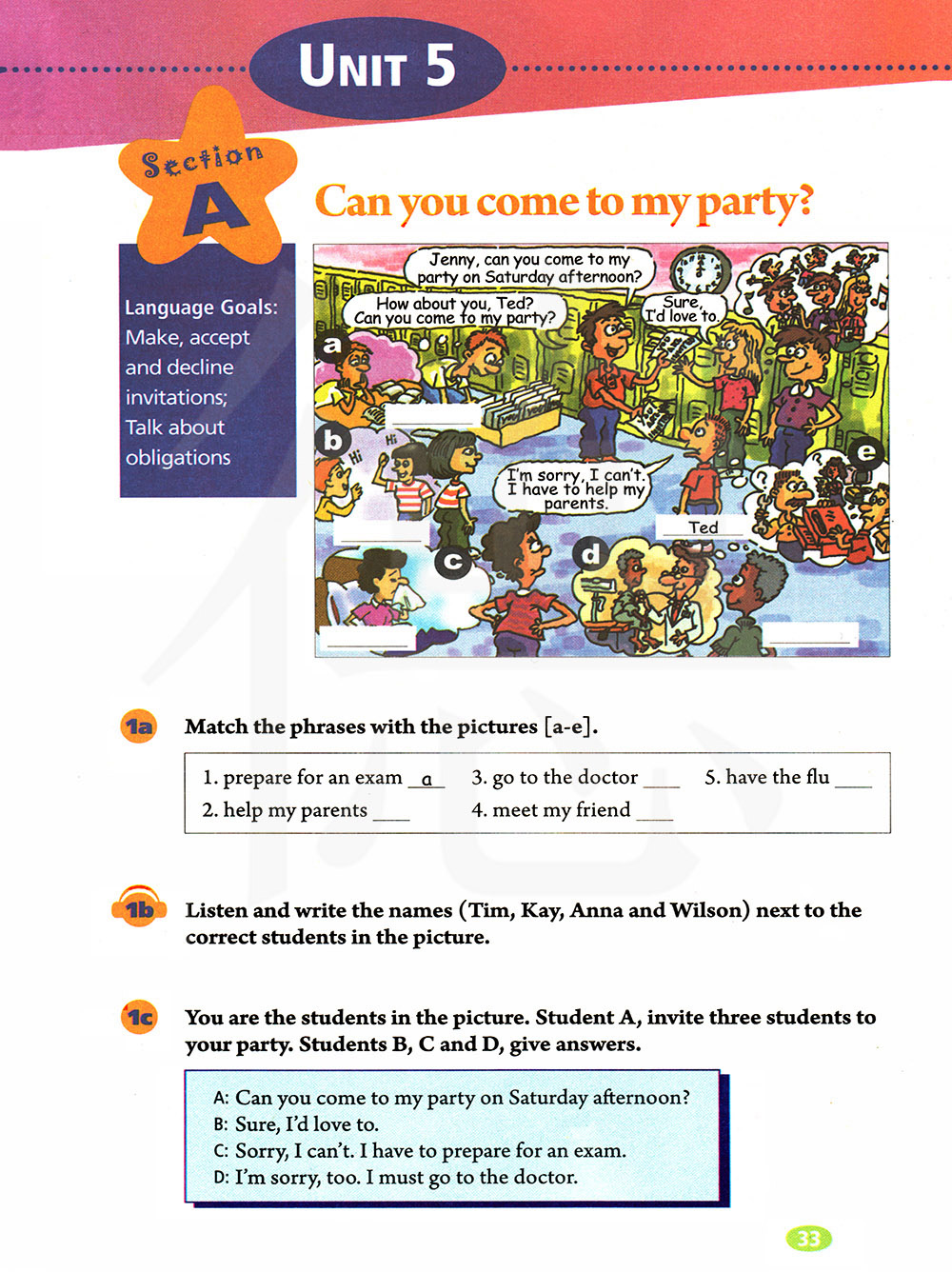
(1) ----Jenny , can you come to my party on Sunday afternoon ?
----Sure , I’d love to .
(2) ----Can you go to the movies in an hour ?
----I’m sorry , I can’t . I have to help my mom .
(3) ----Can you play soccer with us soon ?
----I’m sorry , I can’t . I have tennis training.
(4) ----Can you go to the mall this afternoon ?
----I’m sorry , I can’t . I’m trying to study chemistry .
(5)----Can you go to the doctor with me ?
----I’m sorry , I can’t . I have to finish my project until two o’clock .
(6)----Can you come over to my house next Wednesday evening?
----I’m sorry , I can’t . I have to practice the piano .