知识点
一.短语积累
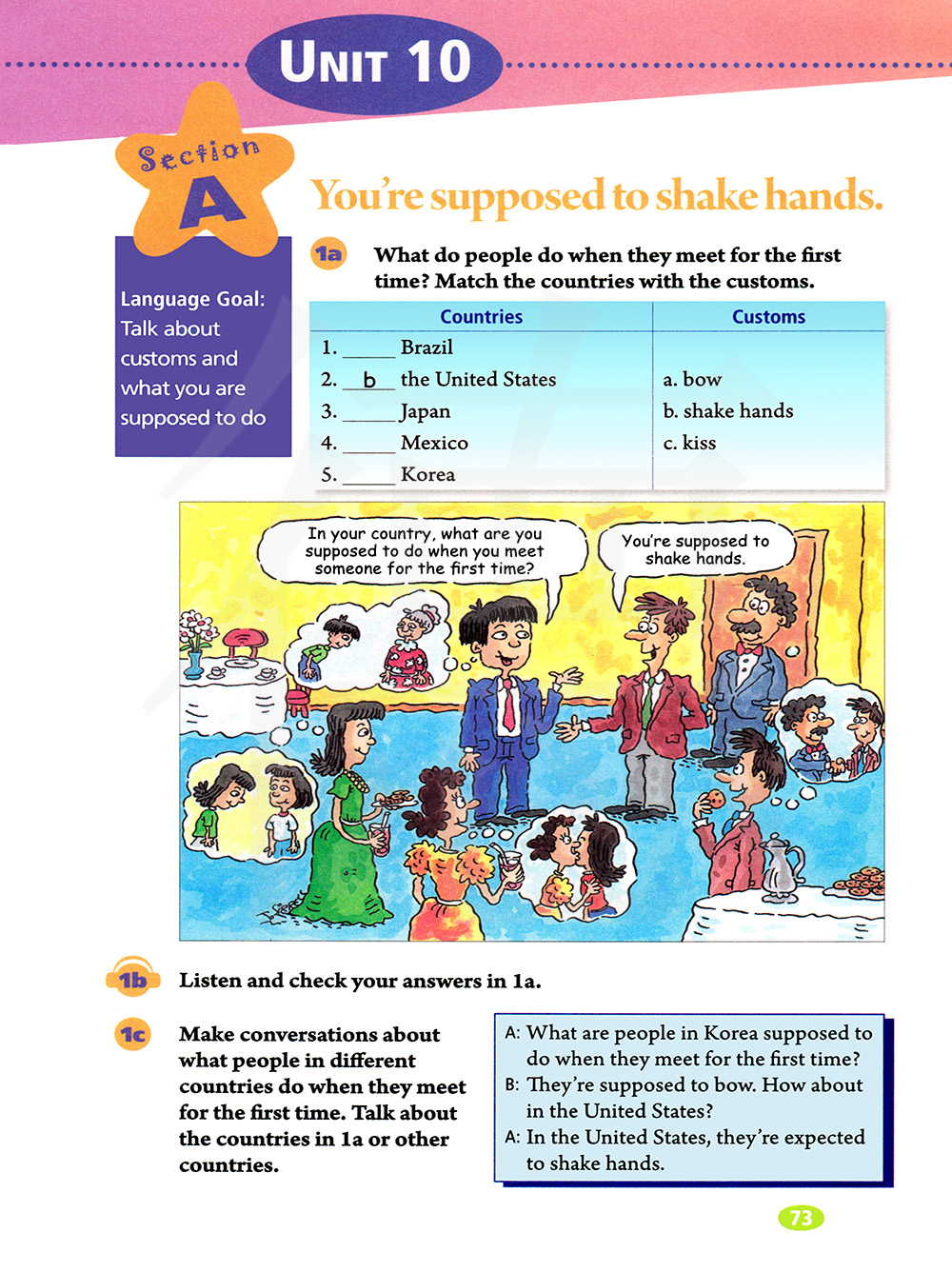
1. be supposed to do 被期望做,应该
2.shake hands 握手
3.be expected to do 被期望做某事
4.as soon as 一…就…
5.to one’s surprise 令人惊讶的是
6. drop by 顺便拜访
7.make plans to do sth. 制定计划做某事
8. as...as sb. can= as...as possible 尽可能…
9. on time 准时
10. after all 毕竟
11.ask/ invite sb. to do sth. 邀请某人做某事
12.make an effort to do sth. 千方百计做某事
13.It’s no big deal.这没有什么大不了的
二.重难点解析
1. be ( not ) supposed to do sth.
suppose v. “认定;假定”的意思,这里用的是被动形式表示:被 (不被)期望 /应该做某事 强调礼仪中该做与不该做的,用来表示劝告、建议、义务、责任等,意思可以相当于should
① You’re supposed to kiss. = You should kiss.
② You are not supposed to smoke here.= You shouldn’t smoke here.
③ It is supposed to be very hot there.据说,大家认为那儿很热。
2. Where I’m from, we’re pretty relaxed about time.在我们那个地方,我们的时间观念比较随意。
* Where I’m from是地点状语从句,where为引导词,“在……的地方”
Where there’s a will, there is a way.
3. It’s Okay if you arrive a bit late.如果你稍微迟一点还行。
a bit在此作状语修饰late,表示“稍微,一点儿”,可以与a little互用,既可修饰形容词、副词的比较级,也可以修饰原级。
She’s feeling a bit tired. a bit of 与a little 可互换用,用于修饰不可数名词 注意:not a bit= not at all表示一点也不,而not a little = very/ very much许多,很,不只一点点
Are you tired? No, not a bit.你累吗? 一点也不累!
4. We don’t usually have to make plans to meet our friends.
make a plan / plans to do 计划做…
We made a plan to go hiking yesterday.
We have made plans for the holidays.
plan还可以作为动词,如计划做某事,用plan to do sth / plan on doing sth. We’re planning to visit Tibet this summer.
Don’t plan on visiting Beijing in winter, because it’s too windy and cold. make plans/ a plan to do sth. 计划做某事﹦plan to do sth.
5. In Switzerland, it’s very important to be on time. it用作形式主语,代替了真正的主语to be 这一不定式,不定式可以作主语,但往往用it作形式主语来代替。To help others is good when they are in trouble. It’s good to help others when they are in trouble.
on time 准时
in time 及时
6 .If you’re even 15 minutes late, your friend may get mad.
get mad 大动肝火,气愤(强调动作和过程)
be mad 感觉很生气(表示状态)
be/ get mad at /with sb.生某人的气
= be/ get angry with sb. be/ get mad about sth. 因某事而生气
6. I always leave the house early to avoid heavy traffic because I think it’s impolite to keep others waiting. 我总是早早离开家以避免交通拥挤因为我认为让别人等待是不礼貌的。
划线部分是一个原因状语从句,其中又含有一个宾语从句。
It’s polite∕rude/ impolite to do sth. 做某事是有礼貌的/不礼貌的
这个句式和以前接触过的句式类似,形式主语是it,后面的动词不定式是真正的主语。It’s rude to point at anyone with your chopsticks.
It’s polite to say hello to your parents when you leave for school. keep sb. doing sth.让某人一直做某事
keep (on) doing sth. 一直做某事
keep sb. from doing sth.
= stop sb.(from) doing sth
= prevent sb. (from) doing sth. 阻止某人做某事
16. you are supposed to / are expected to knock before entering.=befor you enter.(时间状语)
knock vi. 敲门,其后常接介词at/on
v. 碰撞, knock into 与…相撞; knock down 撞到
n.敲击声;敲击 There is a knock at the door.
三.语法精讲:
动词不定式
动词不定时的构成 不定时的基本形式为:to+ 动词原形,有时可以不用to,这里的to 是不定式符号,本身无词义,动词不定式的否定形式是not+(to+ )动词原形。 一、动词不定式的句法功能 功能 例句说明
主语 To speak English is not easy for us=It is not easy for us to speak English. 讲英语对我们来说不容易。
作主语用的不定式,常常用it 作形式主语,而把不定式放在后面。
表语 My work is to clean the room everyday.=To clean the room every day is my work. 我的工作就是每天打扫这间屋子。
多数情况下,不定式作表语,可转换作为主语。
宾语 —What sports does he like to play?他喜欢做什么运动?
—He likes to play basketball.他喜欢打篮球。
只能做某些动词的宾语,一般不作介词的宾语。
宾补 My mother made me play the piano all the time. 我妈妈让我一直弹钢琴。
在make,let,see,hear,watch等使役、感官动词后,不定式省略to。
定语 Have you got anything to say? 你有要说的吗?
不定式作定语,要放在所修饰词的后面。
状语 I'm sorry to trouble you.(表原因)很抱歉,给你添麻烦了。
I went to the library to study English.(表目的)
不定式作状语,其逻辑主语要和句子的主语一致。
1. 不定式作主语
动词不定式作主语时,常用it作形式主语,而将真正的主语放在句末 其结构为:It+be+adj.(+ for/ of sb.)+动词不定式 如:
To learn English well is useful.→ It is useful to learn English well. It’s important for us to protect the environment.
注意:在kind,good,nice,clever等表示人的品质的形容词后,不用for而用of。如:It's very kind of you to help me. 你帮助我真是太好啦。
It's very clever of you to do like that. 你那样做真是太聪明啦。
2. 不定式作宾语
①有些谓语动词后只能用不定式作宾语,常见的这类词是表示命令、打算或希望的,如:would like, like, want, wish, hope, decide, plan, expect等。如:
Would you like to see a film this evening? 你今晚想去看电影吗?
②在find, think,feel, make后跟不定式作宾语时,常用it代替,而将真正的宾语放在后面。如:
I find it easy to read English every day.
③常见的一些不带to的动词不定式
Why not do..., Why don't you do..., had better(not)do..., would rather do, could/would/will you please(not)do...
I would rather stay in the room.我宁愿待在房间里。
④既可接动词不定式又可以接ing 形式作宾语,意思差别不大的动词有begin, start,like, love, hate 等。
Then I start to watch English-language TV. I like to eat vegetables.
3. 不定式作宾语补足语
不定式作宾语补足语时与宾语有逻辑上的主谓关系。如:
Lucy asked him to turn down the radio. 露西让他关小收音机。
tell, ask, want, allow, get, would like, encourage后常跟动词不定式作宾语补足语。如:
My mother encourages me to learn Japanese. 我妈妈鼓励我学日语。
注意:还有一些使役动词和感官动词也用不定式作宾补,这时不定式要省略to。这些动有: 一感(feel)、二听(hear, listen to)、三让(let, make, have)、四看(look at, see, watch, notice)。但变被动语态时,必须加上 to。如:
My friends were made to work the whole night by the boss. 老板让我的朋友们工作了一整夜。
4. 不定式作定语
①不定式作定语时,应放在名词之后。它与名词有逻辑上的动宾关系。
②如果是不及物动词,且与所修饰的词之间有动宾关系,要在不定式后加上适当的介词。 There is nothing to worry about. 没有什么可担心的。
5. 不定式作状语 表示目的、原因、结果或条件。
I came here to see you . (目的)
We were very excited to hear the news. (原因)
He hurried to the school to find nobody there. (结果 )
6. 不定式作表语
My job is to help the patient.
7. 不定式常和疑问词what, which, when, where, how 连用,相当于一个宾语从句。如:
The teacher is telling the students what to do. 老师正告诉学生们做什么。 He didn't know where to go. 他不知道去哪里。
Section B
一. 短语积累
1. point at 指着
2. at the table/ at table 在桌旁/ 在进餐
3. face the biggest challenge 面临最大的挑战
4. on my exchange program 在我的交换生活中
5. There is no reason to do sth. 没有理由做某事
6. go out of one’s way to do sth. 特地做某事
7. make sb. feel at home 使某人感到不拘束
8. learn how to do sth. 学习怎样做某事
9. be comfortable doing sth. 轻松/舒服地做某事
10. at first 起初
11. cut up 切碎
12. find it difficult to do sth. 发现做某事…
13. have a good school year 新学年愉快
14. feel good about doing sth.对干… 感觉不对
15. look forward to doing 盼望做某事
16.best wishes 最美好的祝愿
17. show up 出席,露面
18. learn about了解
19. in different situations 在不同场合
20. travel by car 驱车旅行
二.重难点解析
1.empty adj. 空的,反义:full 满的
v. 倒空 反义:fill 装满
Please empty the bottle.
2. Point at anyone with your chopsticks. 用筷子指着别人。
point…at …瞄准,对着 He is pointing his finger at me.
point…to…指向 The hour hand pointed to twelve.
point…out 指出 The teacher pointed out many mistakes in my homework.
3.start doing sth. = start to do sth. 开始做某事
4. They go out of their way to make me at home. 他们尽力使我感到必至如归
go out of one’s way to do sth 特意(花时间,心血)做某事,故意做某事
He went out his way to help me. make sb. be/feel at home 使某人感觉像在家一样
make sb. adj /do 使某人做某事 Her smile made me feel at home.
5. I thought that was pretty strange at first, but now I’m used to it.
be used to sth/doing sth 习惯于,适应于 I’m not used to speaking like that.
used to do…过去常常 I used to like playing basketball after school.
be used to sth/doing… 习惯于,适应于 I’m used to playing basketball after school.
be used to do… 被用来做 This machine is used to clean the windows.
be used for doing 被用来做 This machine is used for cleaning the windows.
6. Although I still make lots of mistakes, it doesn’t bother me like it used to. 尽管我经常犯一些错,但它不像过去那样困扰我了。
7. make lots of mistakes 犯许多错 bother 打扰,烦扰 Don’t bother your father, he is working.
8. You’re not supposed to eat anything with your hands expect bread, not even fruit!
expect除……之外,但不包括在内,介词
I get up early expect Sunday.
besides 除…之外,还有…
Nobody was late except me.
9. I have to say, I find it difficult to remember everything, but I’m gradually getting used to things, and don’t find them so strange any more.
find it difficult to do sth 发现做某事很难
it 作形式宾语,真正的宾语是动词不定式to do sth He finds it difficult to stop smoking.
get used to sth/doing = be used to sth/doing
10. make an appointment/appointments with sb 与某人约会
11. Let me give you some suggestions and advice about Chinese customs.让我给你一些关于中国风俗的建议和意见。
①give sb. some suggestions and advice 给某人提出一些建议和意见
make/ offer a suggestion 提出建议
ask for a suggestion 征求建议